Retention of A2P SMS Operational Evidence: Periods, Access and Deletion
A guide to organizing A2P SMS evidence by category and purpose, defining access and deletion rules, and handling exceptions without assuming universal retention periods or overstating what DLRs can prove.
Why a single retention period is not a good fit
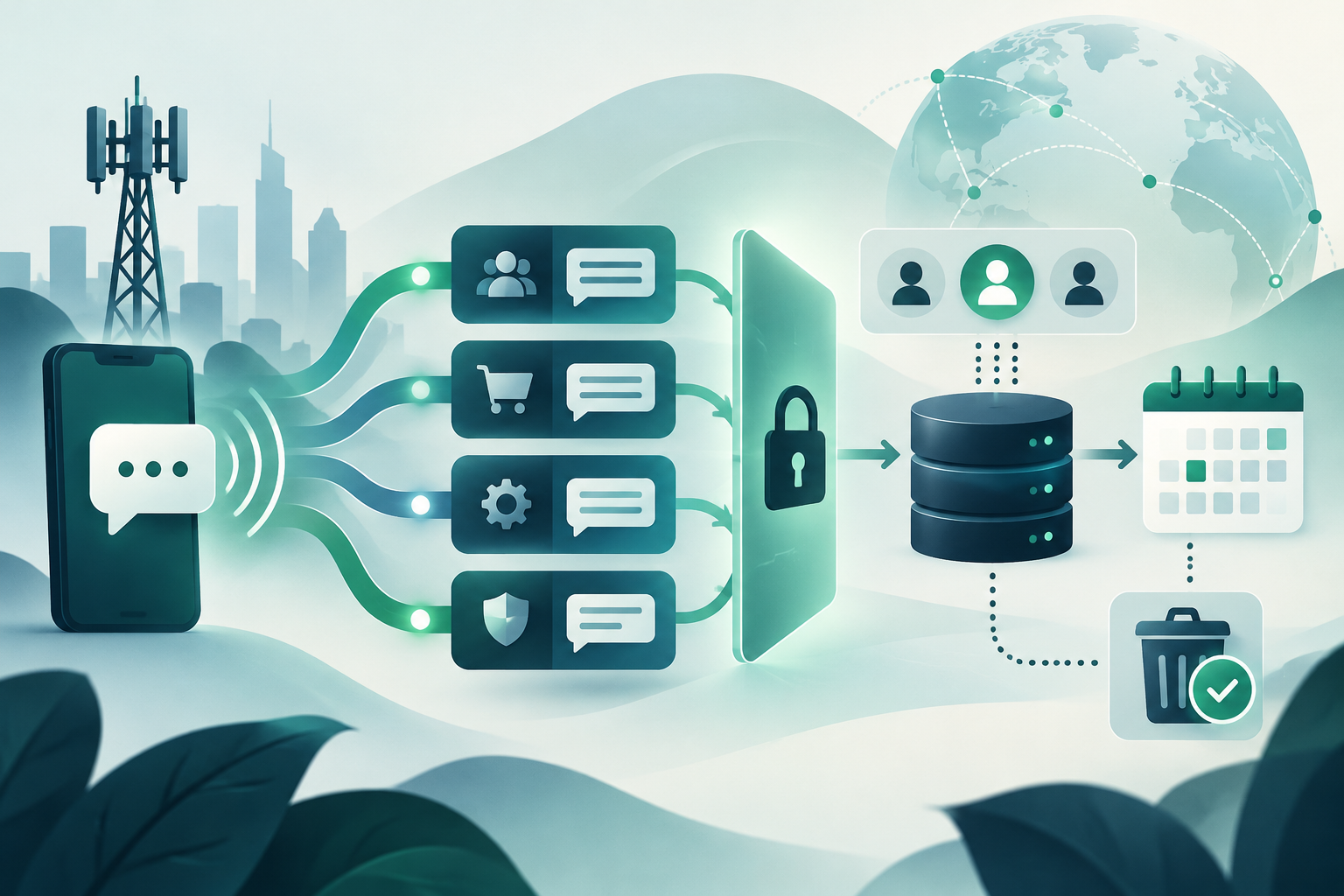
An A2P SMS operation can generate data with different content, uses and risks: sending metadata, delivery statuses, technical traces, billing records and evidence related to contact permissions. Keeping all of it for the same period, with the same access and in the same systems, can make both investigations and data minimization more difficult.
The practical rule is to design retention by category and purpose, rather than copy a generic period. The appropriate period depends on applicable obligations, relevant agreements, documented operational needs and the actual capabilities of each system. This guide is an operational framework; it does not replace a legal assessment.
- Do not set a period until you know what data is being retained and why it is needed.
- Do not treat technical evidence, an invoice and a consent record as equivalent.
- Document who decides the rules and who implements them.

Inventory evidence by category
Start with an inventory of data and systems. For each item, note where it is generated, where it is copied, who controls it, what information it may contain and which processes use it. Include messaging systems, historical stores, support tools, exports and backups, if any.
The following categories are a starting point, not a mandatory list. Adapt them to the architecture and specific services used in the operation.
- Sending metadata: message identifiers, timestamps, destination or other routing fields recorded by the system.
- Statuses and DLRs: statuses reported by components in the messaging chain and their technical context.
- Technical traces: errors, connection events and logs needed to diagnose failures.
- Billing data: records supporting charges, reconciliations or commercial disputes.
- Consent records: evidence held by the relevant controller about permissions, preferences or revocations, as applicable to the workflow.

Link each category to a purpose
Assign each category a specific, verifiable purpose. For example, a trace may be used to diagnose an incident; a billing record to reconcile a transaction; and a status data point to investigate an operational discrepancy. Avoid vague justifications such as “just in case” or “for the business.”
The purpose should help determine which fields are necessary, which teams may access them and which event starts the retention period. If a dataset serves more than one purpose, assess each use separately and avoid retaining all the information longer just because some of it is still needed.
- Describe the specific operational problem or requirement the data helps address.
- Identify the person responsible for the purpose and the technical owner of the system.
- Record which fields are essential and which can be excluded, masked or separated.
- Consider whether less detailed evidence can serve the same purpose.
Set periods and starting events without inventing a universal rule
The available information provides no basis for recommending a universal retention period for A2P SMS evidence. Set the schedule only after checking the obligations that apply to the organization, relevant contracts, justified investigation needs and the technical limitations of the platforms.
As well as the period, document the event that starts it. This may differ by category: for example, creation of the record, completion of an operation or conclusion of an investigation. These are design options, not general legal rules. Define them only when they fit the purpose and can be applied consistently.
Product documentation reviewed describes an architecture that keeps recent messages in Mnesia and uses SQL to archive CDRs. It also shows a configurable 24-hour message retention parameter. These details illustrate options in a particular implementation; they are not a standard, a recommended period or a capability attributable to all platforms.
- Record the basis for each period and who approved it.
- Define the starting event and how expiration is calculated or applied.
- Check that the system configuration matches the approved schedule.
- Review periods when the purpose, obligations or architecture change.
Separate access and keep records of consultations
The policy should specify which roles may access each category and for what purpose. Operations, support, security, compliance and finance may need different evidence; do not assume that everyone needs access to the full content or all exports.
Where the platform allows it, log queries, exports and permission changes. Define how exceptional access is authorized and who reviews those logs. Documentation for one CDR implementation describes options such as encrypting a table, restricting access by column and masking exports; these are possible controls in that product, not guarantees available in every system.
- Assign permissions by role and category, with the narrowest practical scope.
- Set an authorization process for queries outside normal use.
- Where the platform allows it, log the reason, the person authorizing access and the person accessing the data.
- Periodically check that permissions are still necessary.
Design deletion to include copies and exports
Deletion should account for the full data lifecycle: primary system, archive, exports, support tools and backups. Before promising immediate or irreversible deletion, confirm what controls each component offers and how it handles backup copies.
If a system cannot apply the same deletion to every destination, document the limitation, the alternative process and how its execution is checked. For example, the product documentation reviewed describes options to delete the message body or set it to NULL after delivery. This possibility does not mean that all related fields disappear or that other systems have deleted their copies.
- Identify all locations and export paths for each category.
- Define the deletion or data-reduction method available in each system.
- Establish how execution will be verified and recorded, without claiming guarantees the platform does not offer.
- Document how backups are handled and the actual time or mechanism the system allows.
Manage exceptions for open investigations
An active investigation may justify retaining certain evidence beyond the ordinary schedule, if applicable rules and organizational policies allow it. Limit the exception to data related to the case; it should not automatically extend to the entire history.
Create an exception record stating the reason, scope, approver and review date. When the case closes, assess which data still has a documented purpose and apply the ordinary deletion rule to the rest.
- Link each exception to an identifiable case and specific evidence.
- Assign an owner and a review date or event.
- Keep a record of extension decisions and their justification.
- Formally close the exception and resume the relevant schedule.
Explain what each piece of evidence does and does not show
Describe the provenance of each record precisely, including which system generated it, what transformations it may have undergone and what uncertainties apply. A sending record may document an action or event logged by a platform; by itself, it does not prove consent or the identity of the person who received the message.
A DLR is a status reported within the messaging chain. It should not, by itself, be presented as independent confirmation that a person saw the SMS or that it was actually displayed on the handset. Distinguish a reported status from independently verified receipt, if such verification exists.
The product technical documentation reviewed is not enough to establish legal conclusions or determine the evidentiary value of each record. When that assessment affects an obligation or dispute, consult the applicable regulatory sources and obtain competent advice.
- Keep the context needed to interpret the evidence, not just an isolated status.
- State the data source and relevant transformations.
- Do not use a DLR as automatic proof of reading, identity or consent.
- Maintain consent evidence according to the applicable process and requirements, separately from technical sending records.
Frequently asked questions
Is there a universal recommended period for retaining A2P SMS evidence?
No universal period can be established from the available information. Set periods by category and purpose after reviewing applicable obligations, relevant agreements, documented needs and technical capabilities.
Does a DLR prove that the SMS reached the recipient’s phone?
Not by itself. A DLR is a status reported in the messaging chain and does not necessarily amount to independent verification of receipt on the handset. Nor does it prove that a person saw the message.
Does a sending record prove that the recipient gave consent?
No. A sending record documents, at most, events recorded by the platform. It does not replace evidence of consent or, by itself, prove the recipient’s identity.
What should a retention exception for an investigation include?
At a minimum, the reason, the affected evidence, the responsible person, the authorization and a planned review. When the investigation ends, document closure and reapply the ordinary rules to data that no longer needs to be retained.