HTTP and SMPP Credentials in A2P SMS: Least Privilege, Rotation, and Traceability
Design HTTP and SMPP credentials to limit the scope of an exposure, separate functions, rotate secrets without interruption, and reconstruct the activity of each integration.
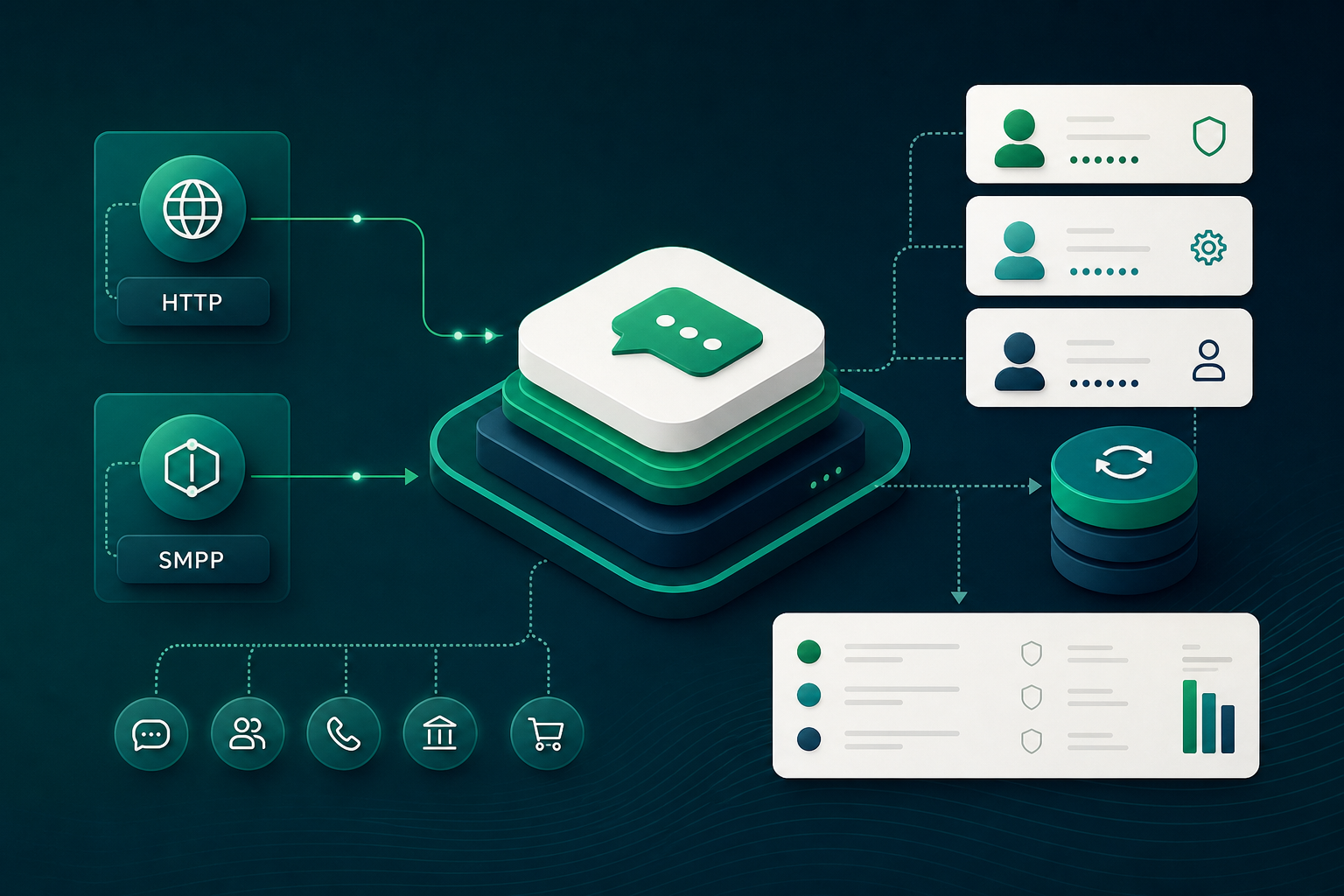
What Operational Risk Does a Credential Policy Address in A2P SMS?
A connectivity credential is more than just an access mechanism. In an A2P SMS operation, it determines which integration can authenticate, which actions it can perform, and what evidence remains if an anomaly occurs. If several applications, environments, or customers share the same secret, an exposure can affect more traffic than necessary and make it harder to attribute use to a specific source.
A well-designed credential policy reduces the blast radius of an exposure. The foundation is to assign a unique technical identity to each relevant integration, restrict its privileges to the intended use, and maintain enough traceability to investigate authentications, submissions, queries, and errors without logging the secret.
There is no universal configuration: the connectivity provider determines which controls it supports for senders, destinations, limits, source IPs, endpoints, or sessions. Therefore, the team must document which restrictions are available, which have been enabled, and which must be compensated for through internal controls.
- Avoid using a single user or token for production, testing, automation, and human operations.
- Associate each credential with a defined technical owner, application, environment, and purpose.
- Treat a sending credential as a high-impact asset: it may enable traffic generation, costs, and activity that requires later investigation.
- Maintain a tested procedure to replace or revoke a credential without relying on improvised manual access.
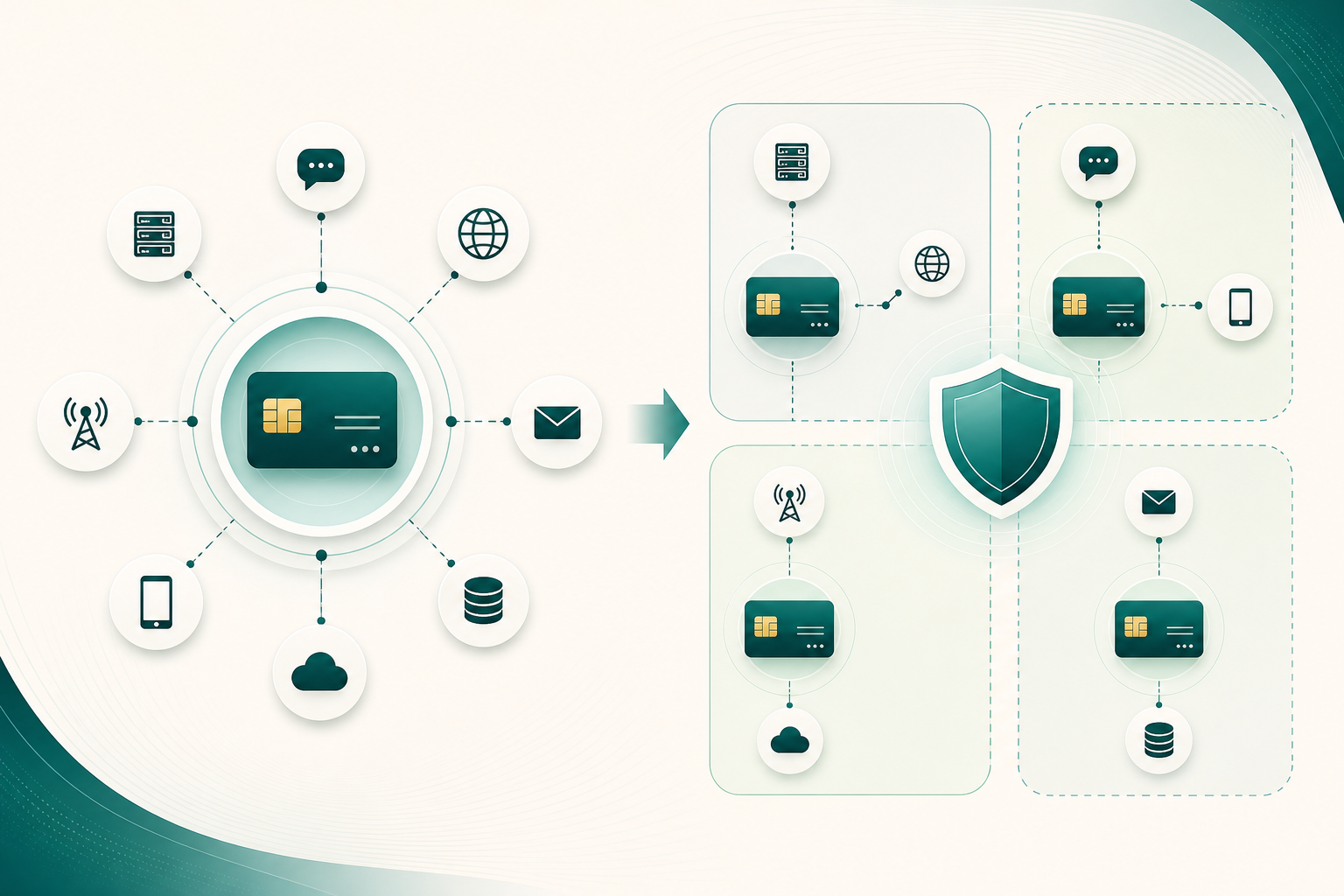
Least Privilege in HTTP APIs and SMPP: Capabilities, Destinations, Senders, and Limits
Least privilege means granting only the access needed for a specific task. In A2P SMS, this should be assessed across more than one dimension: functional capability, environment, application, customer, sender, destination, source network, and permitted volume when the provider offers those controls.
Do not assume that an administrative credential is necessary for an integration that only submits messages. A sending application does not, by default, need permission to modify configuration. A process that queries statuses does not need to send traffic. A callback receiver does not need a credential that allows it to originate messages.
Before creating access, define the expected operation in writing and confirm with the provider which limits it can actually enforce. If a restriction is not available on the connectivity platform, it should not be presented as applied: it must be covered through application, network, operational, or detection controls.
- Capabilities: separate message submission, status queries, callback reception, and configuration administration.
- Commercial and operational scope: where supported by the provider, define authorized senders, destinations or destination groups, and volume or session limits.
- Source: apply IP or network restrictions only if they are supported and the deployment model can maintain them reliably.
- Environment: do not reuse production credentials in development, testing, or pre-production.
- Accountability: a credential must be traceable to an integration and an owner, not only to a generic team.
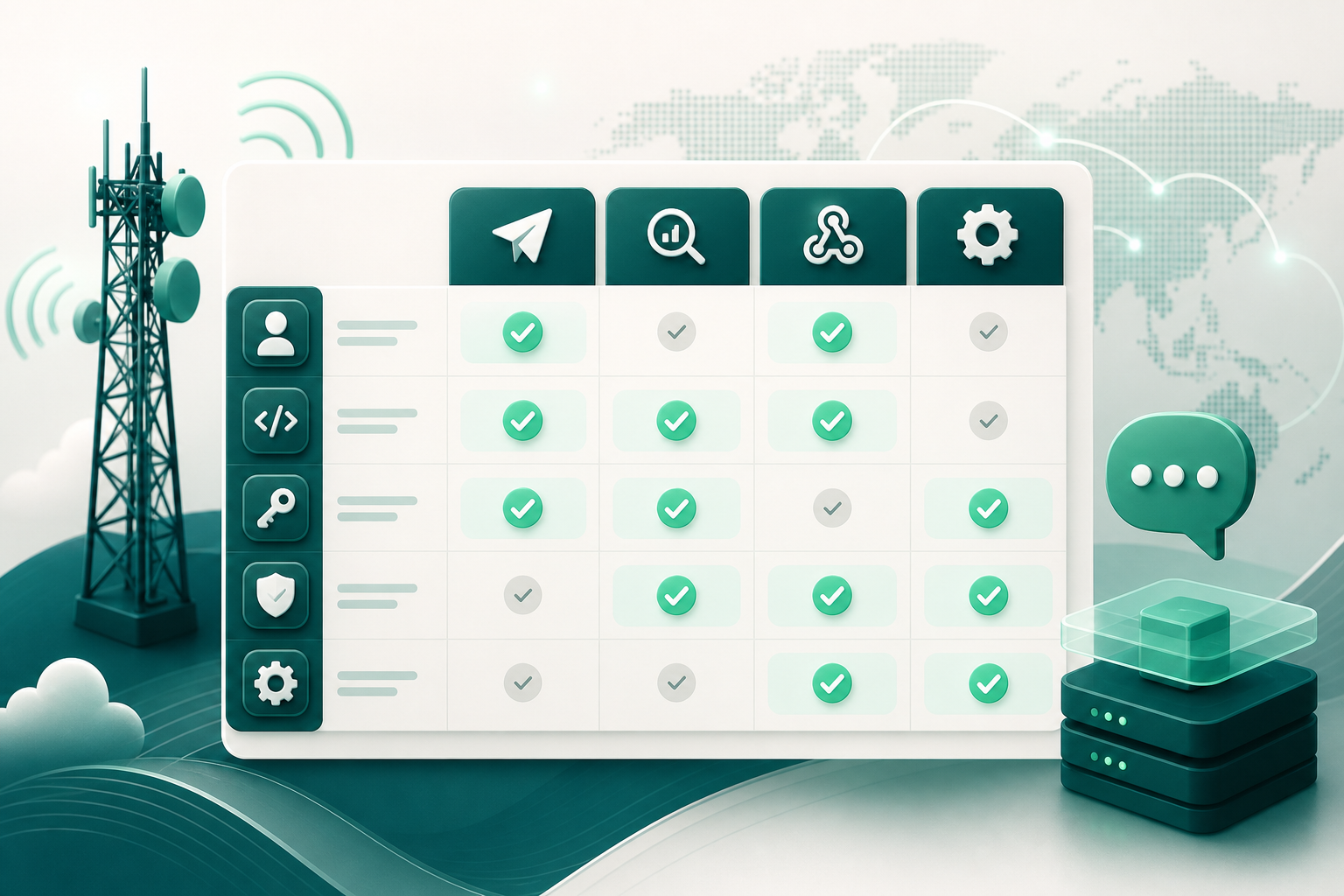
Separate Credentials by Environment, Application, Customer, and Operational Function
Segmentation turns a potential exposure into a contained incident. Separating environments prevents a test from inadvertently using production access. Separating applications prevents a leak in one service from granting access to all others. Separating by customer or operational unit improves attribution and makes it easier to revoke access without stopping unrelated integrations.
It is also advisable to distinguish machine credentials from human access to administration tools. An automated process should have a technical identity with only the strictly necessary scope; an operator who manages configurations should have individual, auditable access subject to granular access controls.
A credential inventory should be able to answer, without revealing the secret value, which integration uses it, who is responsible for it, which environment it operates in, what permissions it has, where it is distributed, and its rotation status.
- Production, pre-production, testing, and development must use different identities.
- Create separate credentials for each consuming application or service.
- Where segregation exists by customer, account, or business unit, avoid shared secrets between them.
- Distinguish automation, administration, and operational support identities.
- Assign a non-secret identifier to each credential for auditing and rotation coordination.
Permission Design for Sending, Statuses, Callbacks, and Administration
A practical model starts with four capabilities: sending messages, querying statuses, receiving callbacks, and administering configuration. These capabilities do not carry the same risk and do not require the same access. Separating them reduces the accidental use of elevated privileges and makes investigations of specific activity clearer.
For HTTP, scopes can express the access scope for protected resources. For SMPP, functional separation can be based on bind type when the platform supports it. In both cases, the approval question is the same: can this identity do something its integration does not need? If the answer is yes, reduce the permission or formally justify the exception.
Callbacks deserve specific treatment. The receiving endpoint should accept only expected traffic, log the correlation information needed, and protect any authentication mechanism agreed with the provider. Do not turn a callback receiver into a channel with sending or administration permissions.
- Sending: enable only the message submission operation required by the integration.
- Statuses: limit access to the queries or events needed for reconciliation and support.
- Callbacks: use a dedicated receiver and keep its responsibilities separate from sending credentials.
- Administration: reserve configuration changes for authorized identities and people, with specific traceability.
- Exceptions: document the reason, owner, time scope, and review date.
SMPP Specifics: system_id, Password, Binds, and Sessions
SMPP defines the bind as the mechanism through which an ESME instance registers with an SMSC, requests a session, and authenticates. During the bind, system_id identifies the ESME and password is used to authenticate it. Both must be treated as sensitive information, especially the password, and must never be included in operational logs in clear text.
SMPP v3.4 includes bind_transmitter, bind_receiver, and bind_transceiver. A transmitter session is authorized to send messages to the SMSC and receive the corresponding SMPP responses. A receiver session receives messages from the SMSC. A transceiver session combines sending and receiving functions in a single session.
Where the provider allows it, using separate sending and receiving sessions or credentials applies least privilege directly. A component that only submits messages does not need to receive messages from the platform, and a component dedicated to receiving does not need sending capability. Exact compatibility, session limits, and the authentication policy must be confirmed with the provider.
In bind_receiver and bind_transceiver, address_range can indicate the set of SME addresses served by the client. If the provider supports and enforces this parameter, review it as part of the session scope; do not assume it is an effective restriction without operational validation. To correlate requests and responses, retain sequence_number in technical telemetry: SMPP requires the associated response to preserve that value.
- Use a system_id per integration or function when the provider can issue separate identities.
- Do not log passwords, unsanitized full PDUs, or data that reveals secrets.
- Choose bind_transmitter for sending components, bind_receiver for receiving components, and bind_transceiver only when the combined function is required.
- Document the bind type, environment, application, purpose, source network, and owner for each session.
- Correlate request and response with sequence_number, without treating it as a substitute for a complete business or audit identifier.
HTTP Specifics: Authentication, Endpoint Authorization, and Tokens
HTTP relies on the security of the underlying connection to transmit confidential fields securely. An integration that exchanges credentials must establish a secure connection before doing so. For bearer tokens, TLS or equivalent transport security is an essential requirement, together with validation of the certificate chain.
Authorization should be evaluated per resource or endpoint, not simply based on whether the token is valid. In an OAuth-based design, scopes express the access requested or granted for protected resources. A token that allows message sending should not be assumed to have access to configuration, reporting, or administrative resources if those permissions are not needed.
Bearer tokens require particular care because anyone who possesses them can use them while they remain valid. A limited lifetime reduces the impact of an exposure. In OAuth architectures that support them, tokens restricted to a specific resource server through audience and tokens bound to the sender through proof of possession reduce the risk of reuse and limit the impact of a leak.
- Require secure transport before exchanging credentials or tokens.
- Define permissions by endpoint and operation, not as generic access to the entire API.
- Use scopes to express minimum permissions when the authorization system supports them.
- Do not send tokens in logs, tickets, screenshots, or shared channels.
- Consider limited-lifetime tokens and, where available, audience restrictions and proof-of-possession mechanisms.
Secret Rotation Without Service Interruption
Rotating a credential is not simply a matter of changing a password or issuing a new token. It must be a controlled transition with a defined overlap window, clear owners, and validation criteria. The goal is to ensure that authorized consumers migrate to the new secret before the old one is retired, without extending the dual-validity period indefinitely.
The recommended operational sequence is to create the new credential, distribute it through the approved mechanism, update consumers, validate authentication and expected traffic, observe errors and residual activity on the old credential, and revoke it at the end of the window. For a compromised credential, urgency may shorten or eliminate the overlap; the team must balance containment and continuity according to the incident.
Manual rotation is prone to errors. Whenever possible, automate secret distribution and replacement. If that is not feasible, support the procedure with a step-by-step checklist, controlled rollback, available owners, and test evidence.
- Define the duration and closing date of the overlap window in advance.
- Assign an identifier to the new credential and retain the old one only as a non-secret reference.
- Check authentication, permitted operations, expected traffic, and the absence of authorization failures after the change.
- Monitor residual use of the old credential before revoking it.
- Test the procedure in a non-production environment where possible.
- Document what to do if a consumer cannot migrate within the window.
Secret Storage and Distribution: What to Avoid
Secrets must not be embedded in clear text in repositories, configuration files, or configuration management tools. They must also be excluded from tickets, shared documents, internal messages, screenshots, and diagnostic dumps. Once a secret is dispersed through those channels, inventorying, removing, and attributing it become difficult.
Centralize the secret lifecycle: storage, provisioning, auditing, rotation, and revocation. Access to the secret management system must also follow least privilege; an engineer does not need to read every secret in the organization to operate a specific integration.
Teams must plan how runtime processes receive a credential without printing it. The answer depends on the available architecture, but the principle is constant: deliver the secret only to the authorized component, for the time required, with enough access evidence for auditing.
- Avoid secrets in source code, version-controlled configuration, and repositories.
- Avoid copying secrets into tickets, chats, spreadsheets, documents, and screenshots.
- Do not print authorization headers, SMPP passwords, or full token values in diagnostics.
- Centralize lifecycle management and limit access by object or component.
- Maintain non-secret metadata: owner, purpose, environment, creation date, rotation status, and review date.
Frequently asked questions
Should every application use a different SMPP or HTTP credential?
As a design rule, yes: a separate technical identity for each application, environment, and function improves attribution and limits the impact of an exposure. Final implementation depends on the identities and controls supported by the connectivity provider.
When should bind_transmitter, bind_receiver, or bind_transceiver be used?
Use bind_transmitter for a component that only submits messages and bind_receiver for one that only receives messages from the SMSC. Bind_transceiver combines both functions in one session. Where possible, separating transmission and reception reduces unnecessary privileges.
What should be logged in an A2P SMS credential audit?
Log non-secret metadata: time, source, technical identity, integration, environment, action, object or endpoint, bind type, result, reason, error codes, and correlation identifiers. Minimize content and personal data according to need and applicable rules.
Can tokens or passwords be stored in logs to investigate incidents?
No. Access tokens, passwords, and other primary secrets must not be logged directly. They should be removed, masked, sanitized, hashed, or encrypted before diagnostic information is persisted.
How can a credential be rotated without interrupting traffic?
Create a new credential, update authorized consumers, validate authentication and traffic, observe use of the previous credential during a defined window, and revoke it at the end. If compromise is suspected, prioritize containment and adjust the overlap according to risk.
What should be done if a credential may have been exposed?
Activate containment through revocation or controlled replacement, review associated authentications and operations, preserve enough logs to reconstruct activity, and avoid exposing secrets again during the investigation. The procedure should be documented before an incident occurs.
Sources consulted
- SMPP Protocol Specification v3.4, Issue 1.2SMPP Developers Forum
- Secrets Management Cheat SheetOWASP Foundation
- Logging Cheat SheetOWASP Foundation
- RFC 9110: HTTP SemanticsIETF / RFC Editor
- RFC 6750: The OAuth 2.0 Authorization Framework: Bearer Token UsageIETF / RFC Editor
- RFC 9700: Best Current Practice for OAuth 2.0 SecurityIETF / RFC Editor