SMS Status Webhooks: Security, Reliability, and Traceability
A design guide to receiving SMS status callbacks with prudent controls, asynchronous processing, and logs that distinguish between a received event and a verified delivery.

What an SMS Status Webhook Reports—and What It Does Not Prove
A webhook is a mechanism that lets one system automatically send events to another. In an SMS integration, the provider may report message-related statuses, but the specific event, its fields, and its meaning depend on that provider’s documentation and contract. The available technical information does not establish a common SMS status schema across all providers.
This guide presents design principles, not a provider specification. As a general reference on webhooks, emBlue’s documentation describes their use for automatically receiving communications events in your own systems; it does not document SMS statuses or the behavior of a specific SMS provider. Always consult the official documentation for the provider you have integrated.
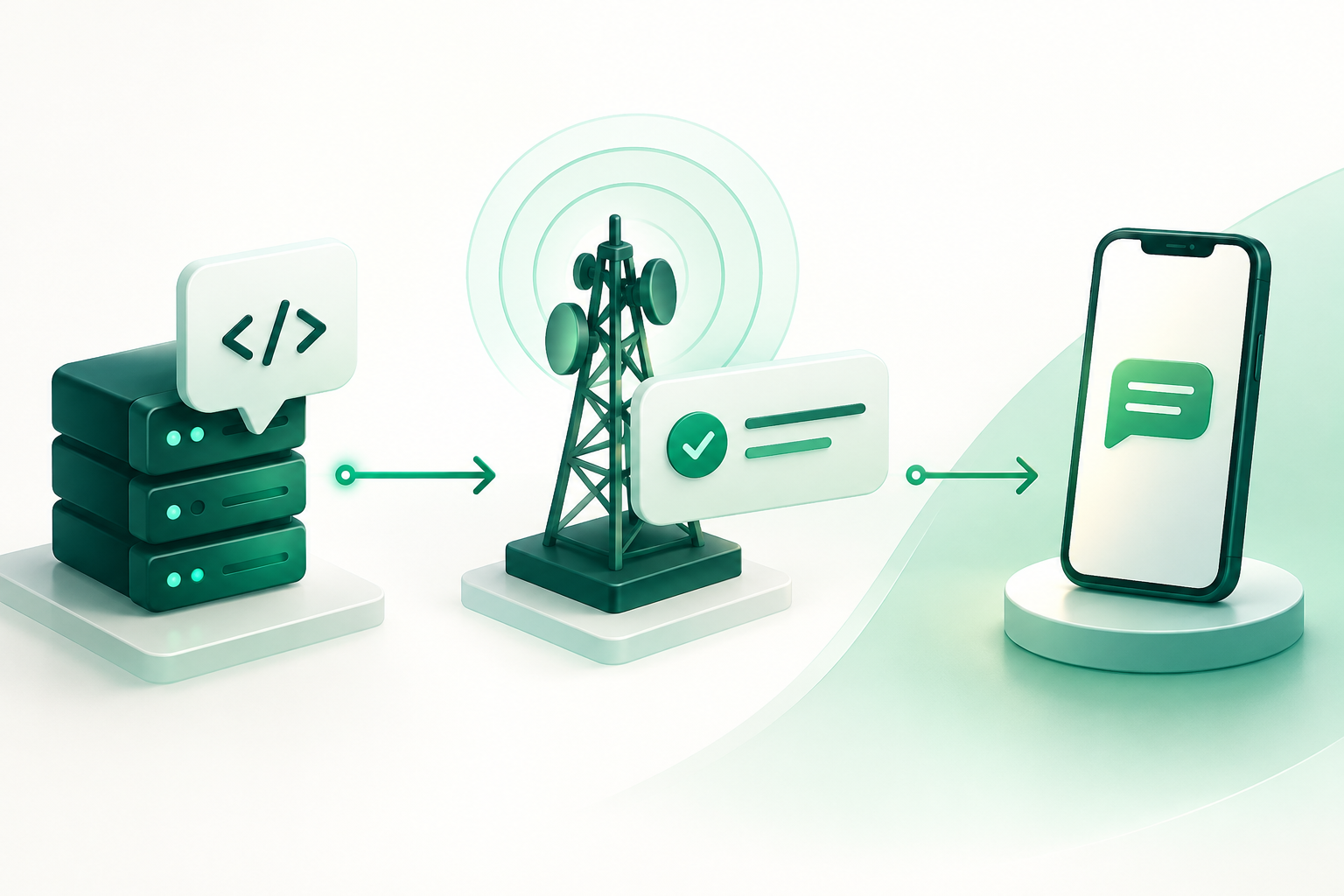
It is useful to distinguish three facts: that the callback reached your endpoint, that the provider reported a status, and that independent evidence confirms receipt on the device. Recording the first does not prove the second; a reported status does not, by itself, prove the third. Preserve this distinction in your reports and business logic.
- Document the meaning of each status according to the provider’s official definition.
- Record the data source and avoid labeling a delivery as “verified” when the only evidence is a status reported by the provider.
- When you cannot confirm receipt on the device, state that uncertainty rather than inferring a guarantee.
Threat Model: Spoofing, Replay, Overload, and Loss
A callback endpoint exposed to the internet may receive unexpected requests, repeated events, or traffic volumes that exceed its capacity. It may also stop receiving events because of network or sender-system failures. The available evidence does not establish a common provider policy for authentication, limits, retries, or retention; verify each point in the official documentation and integration contract.
Design controls to detect invalid requests and protect availability, but do not assume an event is authentic solely because it comes from a known IP address. Addresses and ranges can change, and IP filtering is useful only when the provider documents how to maintain them.
- Identify which documented mechanism can authenticate or validate the request.
- Check payload-size and request-rate limits, timeouts, and retry policies before setting your own thresholds.
- Set alerts for traffic spikes, validation errors, and periods when expected events do not arrive.

Validate the Source and Authenticity Without Assuming Capabilities
Authentication must match what the provider actually offers and documents. If it provides a verifiable mechanism, such as a callback signature or credential, follow its specification and protect the secrets. Do not claim that a signature, reliable IP allowlist, or universal authentication format exists for SMS webhooks.
If the provider does not document a sufficient method for validating the source, ask for clarification before treating events as trusted. Keep the endpoint limited to receiving events, and do not put sensitive credentials in the URL.
The endpoint should use HTTPS to protect data in transit. HTTPS alone does not authenticate the sender: also validate the request using the provider’s documented mechanism.
- Confirm in the official documentation what authentication data is sent and how it should be validated.
- Apply IP validation only if the provider publishes the method and current ranges, and define how you will update them.
- Reject requests that do not meet the agreed mechanism, and log the reason without storing secrets.
- Use HTTPS for the endpoint; do not treat it as proof of the sender’s identity.
Robust Reception: Validate and Respond Without Blocking Processing
Separate reception from downstream work. The endpoint can validate the format and required fields, durably store the event, and put it in a queue so other processes can update statuses or generate alerts. The response should be quick, but the accepted success code and response deadline depend on the provider’s contract: confirm them before implementation.
Validate the documented content type, schema, and required fields. Set payload-size and request-rate limits that fit the contract and your capacity. Do not invent universal limits: the available technical information does not establish common maximum payload sizes or callback rates for SMS.
- Check the structure and accepted values against the provider’s specification.
- Store the original event or a safe representation before confirming receipt.
- Send intensive processing to a queue, and monitor errors, backlog, and message age.
- Set response codes, timeouts, and limits according to the documentation; test how the sender responds in each case.
Idempotency and Deduplication Using Available Identifiers
The same event may appear more than once because of retries or other delivery conditions, but you cannot assume that every provider resends events or includes a globally unique identifier. Examine the official schema to determine which identifiers exist, their scope, and their guarantees.
If a documented event identifier is available, use it as part of a deduplication key within the scope specified by the provider. If there is no such identifier, a fingerprint built from stable fields may help, but it does not prove that two records are identical or replace a provider guarantee. Preserve the received event and record when a deduplication decision is heuristic.
- Do not use a message identifier as an event identifier without confirming its meaning.
- Make repeated status updates safe so they do not duplicate side effects.
- Record the key used and why an event was accepted, marked as a duplicate, or left pending review.
Duplicate, Late, or Out-of-Order Events
Do not assume events arrive only once or in the order in which they occurred. The available documentation does not establish general ordering guarantees for SMS webhooks. Preserve each event with its receipt time and, when provided, its event timestamp; do not confuse the two.
Define explicit rules for deriving an effective status. For example, document which transitions your system accepts and how it handles a late event that appears to contradict a later one. If status semantics are unclear, preserve the observed sequence and mark the result as uncertain rather than inventing a definitive order.
- Store the event history rather than overwriting it with only the latest value.
- Keep the timestamp reported by the provider separate from the time your system received the callback.
- Test duplicates, late events, and contradictory sequences using rules that can be reviewed.
Retries and Failure Handling
Retries may occur at the sender or in your system, but their existence, duration, intervals, and conditions depend on the provider and contract. Do not assume a failed callback will be resent or that retries will continue indefinitely. Verify which HTTP responses count as successful, how long retries continue, and what happens when attempts are exhausted.
On your side, establish a policy for temporary and permanent errors. Use progressive delays and retry limits suited to your operation, log events that could not be processed, and define a review or replay procedure. These are design decisions for your system, not guarantees from the sender.
- Obtain and record the provider’s official retry policy, including what happens when attempts are exhausted.
- Distinguish validation failures, temporary infrastructure errors, and permanent processing failures.
- Avoid unlimited retries; set limits and alerts, and use a review queue for unresolved cases.
- Ensure that replaying an event does not duplicate business actions.
Observability and Reconciliation Without Overstating Verification
Measure the health of the flow using indicators you can observe directly: callbacks received, rejected, and processed; delays between receipt and processing; duplicate events; errors; and pending items. Interpret any comparison with message statuses in light of the scope of the records and the semantics defined by the provider.
If the provider offers a status lookup or event report, verify its availability, coverage, and retention rules in the official documentation before designing a reconciliation process. The available technical information does not confirm that a common lookup method exists. A comparison may reveal discrepancies, but does not, on its own, prove what happened on the device.
- Set alerts for interruptions in callback reception, queue buildup, increased errors, and unprocessed events.
- Compare only sources whose identifiers, time periods, and meanings are compatible.
- Label each result according to its evidence: callback received, status reported, or independently verified.
- Document discrepancies you cannot resolve with the available data.
Frequently asked questions
Does a delivery-status webhook confirm that the SMS reached the phone?
Not necessarily. It confirms that the provider reported that status. Independent evidence is needed to claim receipt on the device; that conclusion should not be inferred from the callback alone.
Can I validate all SMS callbacks using an IP address allowlist?
Not as a universal rule. Use IP allowlists only if the provider documents the ranges, how long they remain valid, and the update procedure. Also confirm which authenticity mechanism it supports.
Which identifier should I use to deduplicate events?
Use the event identifier documented by the provider, if one exists and its scope is specified. Do not assume that a message identifier is unique per event or globally unique.
What should I do if retries or event ordering are not documented?
Ask the provider to confirm, and design your system to preserve history, detect duplicates, and process events idempotently. Do not base operational guarantees on undocumented behavior.