A2P SMS Data Retention: How to Organize Records and Retention Periods
A guide to inventorying A2P SMS data, assigning purposes and controls, and defining retention periods without applying universal time limits.

Why separate data across an A2P SMS chain
An A2P SMS operation can generate different records: message content, transaction identifiers, sender and recipient numbers, timestamps, system responses, delivery statuses, or evidence associated with consent. These records do not all serve the same purpose or require the same access controls or retention periods.
For each category, a retention policy should specify what data is kept, for what purpose, who is responsible for deciding, who can access it, and how it is deleted. Data protection by design and by default provides a useful framework for designing these processing activities with privacy in mind from the outset; specific measures should be adapted to the context and applicable obligations.
- Avoid accumulating data “just in case” without a documented purpose.
- Do not assume that all participants in the chain—the sending business, aggregator, provider, or traffic recipient—have the same responsibilities.
- Document decisions and review the policy when uses, systems, or applicable requirements change.
Inventory data categories and purposes
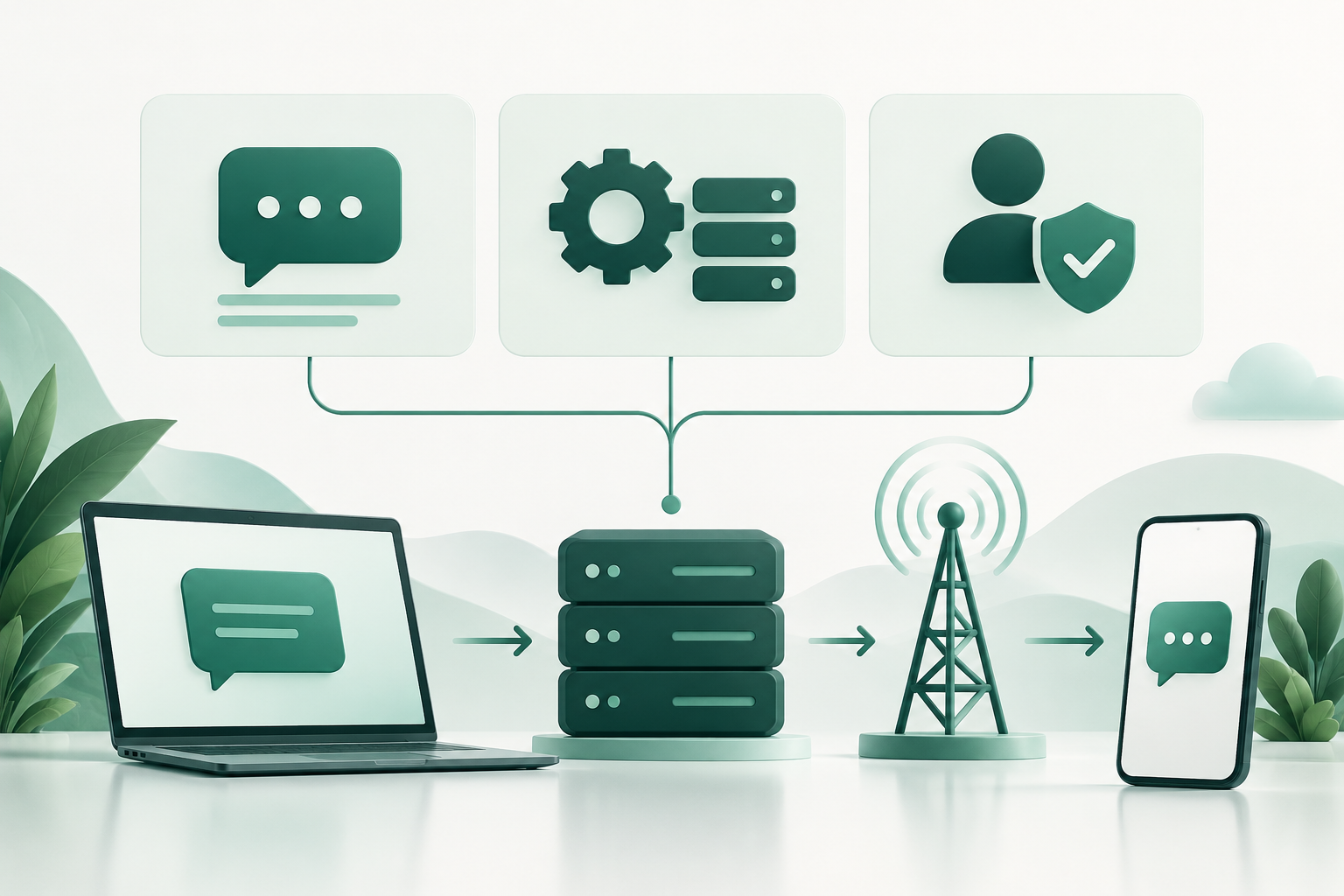
Start by mapping the message journey and identifying which systems generate or receive records. The inventory should describe actual fields and uses, not generic categories that obscure important differences. For example, a transaction identifier may help investigate an incident, while evidence of consent may support the administration of an authorization. These are distinct purposes and should be assessed separately.
Message content warrants particular attention: depending on the context, it may include sensitive information, such as a one-time passcode or transaction details. If the full text is not needed for an operational purpose, consider whether retaining an identifier, status, or less detailed reference would be sufficient.
- Content: the SMS body and, if applicable, the templates or variables used.
- Identifiers and metadata: message references, origin and destination, timestamps, and associated technical data.
- Statuses and DLRs: events or responses recorded by systems, including their source and operational meaning.
- Consent: available evidence, its source and date, and its connection to the recipient or campaign.
- For each category, note the purpose, source system, decision-maker, authorized users, and planned deletion rule.

Set retention periods based on purpose and obligations
The available information does not establish a basis for setting a universal retention period for A2P SMS logs, DLRs, or consent evidence. The period should be determined based on the specific purpose, jurisdiction, role of each entity, and applicable legal, regulatory, or contractual obligations.
For each category, document why it needs to be retained, what event starts the retention period, and what event permits deletion. If an obligation requires data to be kept for a certain period, record the reason and precise scope rather than automatically extending retention for all related records.
- Consult legal or privacy counsel to validate periods in the relevant jurisdictions and sectors.
- Set separate periods by purpose: troubleshooting, operational reconciliation, and consent management may require different assessments.
- Schedule periodic reviews to confirm that the purpose remains valid and the retention period is still justified.
- Document exceptions, such as a legal hold, including its scope, owner, and end condition.
Minimize and separate content from metadata
Minimization starts with deciding what to log. If an incident can be investigated using an identifier and a status, storing the full message as well may not be necessary for that purpose. Consider separating content from operational metadata so that teams checking statuses or reconciling operations do not automatically have access to the SMS text.
Where compatible with the purpose and operational needs, consider pseudonymization or reducing direct identifiers. These measures do not automatically make data anonymous or eliminate the need to protect it; their effectiveness depends on how they are implemented and whether the data can be linked back to an individual.
- Record only the fields needed for each defined purpose.
- Separate content and metadata repositories or views where system design allows.
- Consider whether identifiers can be reduced or pseudonymized without preventing legitimate operations.
- Review whether full message content can be excluded from logs, exports, and support tools.
Restrict access and exports
Access should correspond to a specific task. A troubleshooting team may need to consult technical records, but not necessarily consent evidence or the full message content. The EDPB guidance reminds controllers and processors to implement appropriate technical and organizational measures to protect personal data; access design should put this obligation into practice.
Define who can view each category, for what reason, and through which mechanism. Where feasible, log queries and limit exports, which can create copies that are difficult to control on local devices, in tickets, or in analytics tools.
- Assign permissions by role and data category, not just by team membership.
- Require an operational justification for exceptional access to content or identifying data.
- Log queries and exports where the systems and context allow.
- Review permissions and access periodically, including those for support and administrator accounts.
Plan verifiable deletion
A policy is incomplete if it defines retention periods but does not explain how deletion is carried out. Identify where copies may remain: active systems, replicas, exports, analytics tools, and backups. Deletion techniques and options depend on the architecture; the available information does not establish a single technical method for A2P SMS.
Design a procedure that makes it possible to verify deletion in the intended systems and addresses backups in line with available capabilities and applicable rules. If a specific copy cannot be deleted immediately, document the limitation, measures to restrict its use, and the planned handling when it is restored or its lifecycle ends.
- Maintain a map of systems and copies that may contain each category.
- Automate deletion where feasible and validate the result using appropriate controls.
- Document exceptions and technical limits rather than promising deletion the system cannot guarantee.
- Include rules to prevent deleted data from being reintroduced without a valid purpose.
Handle requests and exceptional retention
Requests for access or deletion and legal holds require defined procedures, but their scope and handling depend on the jurisdiction and circumstances. Consult qualified counsel to establish how to verify, locate, and respond to each request, and how to address potential conflicts with applicable obligations.
Maintain traceability of decisions without unnecessarily retaining the data covered by a request. If a hold prevents some information from being deleted, specify which records are retained, why, who approved the exception, and when it must be reviewed.
- Define a channel and designate owners to receive and coordinate requests.
- Document the searches performed, the decision made, and its basis.
- Limit exceptional retention to the data and purposes necessary.
- Schedule a review to close the exception when it no longer applies.
Use logs and DLRs with clear limits
Operational records can help reconstruct an incident or reconcile events between systems, provided their source and meaning are understood. Document which component generates each status and what it represents in that specific flow. Do not assume that all statuses have the same level of certainty.
A reported DLR does not, by itself, prove that a message was displayed or received on the handset, nor does it establish the recipient’s consent. Use it as an operational signal within the context of the route and systems involved, not as conclusive proof of receipt or authorization.
- Keep the event’s provenance and the timestamp recorded by the system that generated it.
- Distinguish between sent messages, network or provider responses, and independently verified receipt, if such verification exists.
- Do not use a delivery status as a substitute for consent evidence.
- When investigating failures, combine relevant records without extending retention for categories unrelated to the incident.
Frequently asked questions
How long should A2P SMS logs be retained?
There is no universal retention period that can be recommended for all A2P SMS logs. Set the period by category and purpose, and validate it with legal counsel based on the jurisdiction and applicable obligations.
Does a DLR prove that an SMS reached the recipient’s phone?
Not by itself. A reported DLR is an operational event whose interpretation depends on the system that generated it; it should not automatically be presented as independent proof of receipt on the handset.
Can a DLR serve as proof of consent?
No. A delivery status and evidence of consent address different questions. Consent should be managed and documented according to the rules applicable to the case.
Which data should be separated in the policy?
At a minimum, assess content, identifiers and timestamps, statuses and DLRs, and consent evidence separately. For each category, define its purpose, owner, access, retention period, and deletion method.
How should records in backups be deleted?
This depends on the architecture and applicable obligations. Identify the backups, document technical limitations, and define controls to restrict use and handle the data upon restoration or at the end of the backup lifecycle.
Sources consulted
- Guía de Protección de Datos por DefectoAgencia Española de Protección de Datos (AEPD)
- Datos personales segurosEuropean Data Protection Board (EDPB)