Late DLRs in A2P SMS: How to Define an Observation Window and Close Messages Without Losing Traceability
Late DLRs require clear separation between the application timeout, SMS validity, and the internal observation window. This framework helps close operations without deleting evidence or confusing acceptance, delivery, and handset receipt.

What a Late DLR Is in an A2P SMS Chain
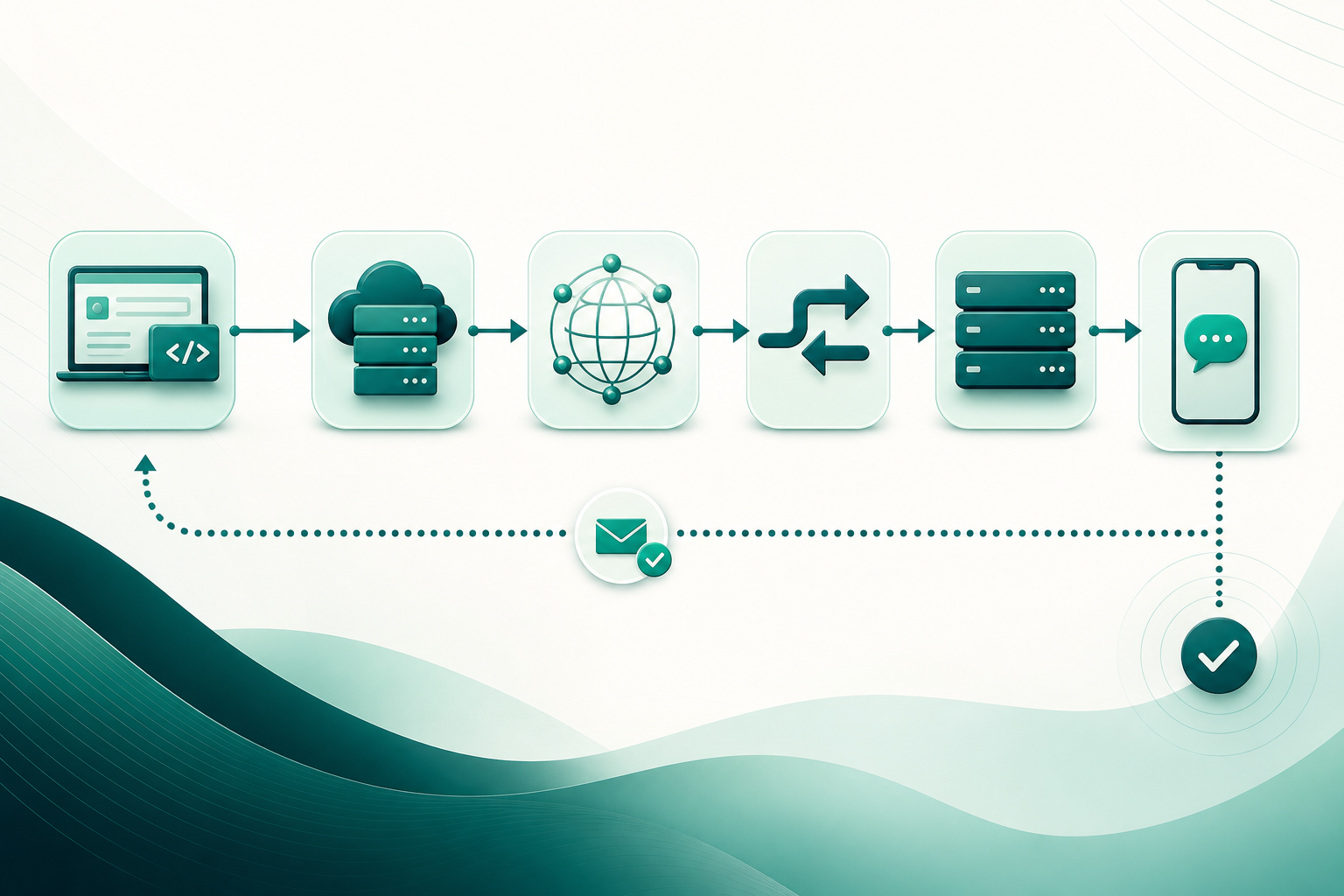
A delivery receipt, or DLR, is a status event related to a previously submitted SMS. In SMPP, when requested through registered_delivery, the SMSC can send that receipt to the ESME through deliver_sm. It is not the synchronous response to submit_sm and must not be treated as one.
A late DLR is a receipt that arrives after the point at which an application, an operations team, or a support team expected to make a decision. It may occur because the message lifecycle passes through multiple systems and because intermediate delivery attempts may take place. SMPP provides, for example, for an attempt to fail while the SMS remains held for further attempts; specific support for such notifications depends on the SMSC and provider implementation.
The lateness of an event does not in itself invalidate the event. It indicates that the company’s operational decision and the notification lifecycle in the delivery chain were not necessarily synchronized. This is why it is useful to design operational closure that is reversible in interpretation, but non-destructive in data terms.
- Do not equate the submission acceptance response with a DLR.
- Do not treat the absence of a callback as automatic evidence of final failure.
- Keep the raw event even when it arrives after operational closure.
- Keep provider-received semantics separate from internal classification.
Three Clocks That Must Not Be Confused
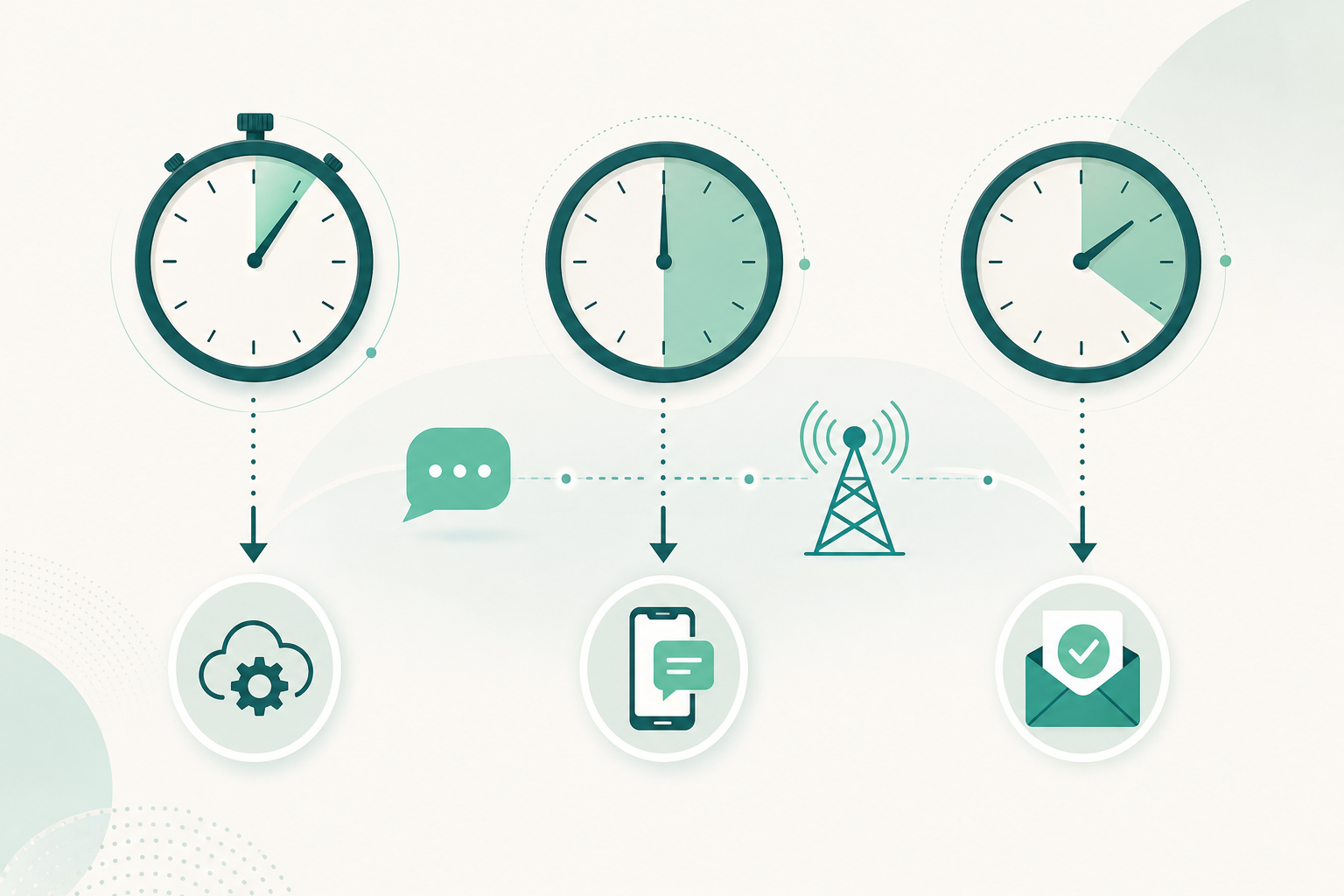
Managing late DLRs begins with separating three controls that answer different questions. When they are used as though they were the same, premature closures, misinterpreted expirations, and unreliable diagnostics follow.
The API timeout determines how long the application waits for a technical response to its request. If it expires, the application must resolve uncertainty about that request using a correlation identifier, a status query, or a safe retry strategy. It does not determine how long the SMS can be delivered or how long a DLR may take to arrive.
The validity period determines until when a service center may retain a message in order to attempt delivery. In SMPP, validity_period represents the expiry time after which the SMSC must discard the message if it has not been delivered. In 3GPP, validity can be expressed in relative, absolute, or enhanced formats. Validity expiry is a network outcome; it must not be inferred simply because no callback has arrived.
The DLR observation window is an internal operational policy. It defines how long an outcome is expected for business workflows, alerts, support, or operational reporting. It is not set by the protocol and must not be made equivalent to the timeout or mechanically copied from the validity period.
- API timeout: waiting limit for a technical response.
- Message validity: retention and delivery-attempt limit in the applicable part of the chain.
- Observation window: internal limit for deciding an operational state, not for deleting evidence.
- Reconciliation period: subsequent interval for recovering or checking missing events and late changes.
Why “Accepted” or “Sent” Does Not Confirm Delivery
An acceptance or sent status must be described precisely. In documented provider semantics, sent means that the nearest upstream carrier accepted the message. That does not equal confirmation of delivery to the destination.
Even when a DLR indicates delivered, communication should retain the actual scope of the evidence. The 3GPP specification distinguishes between a message received by the SME and a message forwarded by the service center without the service center being able to confirm its delivery. In addition, the evidence a provider can expose depends on confirmation available from the carrier and, where available, from the handset.
Therefore, a delivered status should be recorded as delivery confirmation reported by the available chain, not as universal, independent proof or as the equivalent of being read by the recipient. Reading, understanding, and performing an action in a business workflow are facts distinct from the DLR.
- Accepted: the request or message was admitted at a point in the chain.
- Sent: may reflect upstream transfer or acceptance, depending on documented semantics.
- Delivered: reflects a reported confirmation whose scope depends on available evidence.
- Read, used, or converted: require independent application or user signals.
How to Model Internal States Without Overwriting Evidence
Callbacks are asynchronous, and a message’s status can change throughout its lifecycle. Therefore, a provider’s raw status should not be the only field governing operations. It is advisable to maintain an immutable event history and a computed internal view for each message.
A practical model can use pending, provisional, final, and late updated. These names describe the company’s operational posture; they do not replace the original DLR semantics. The record must retain both the received event and the rule used to interpret it.
Pending can represent technical acceptance or the fact that a sufficient outcome has not yet been received. Provisional indicates that a business or support action has been taken under explicit uncertainty. Final identifies an outcome received and classified under the current rules. Late updated indicates that a later event changed the computed view or provided relevant information after operational closure.
An earlier state should not be replaced, nor should events be deleted because they appear redundant. Keep the sequence and compute the current view using versioned rules. This makes it possible to explain why a message was closed at a given point and why its interpretation was later updated.
- Raw event: received content, identifier, source, and receipt time.
- Normalized status: controlled translation of external semantics.
- Operational status: pending, provisional, final, or late updated.
- Transition reason: applied rule, rule version, and actor where there was manual intervention.
- Reconciliation status: confirmed by received events, queried, pending review, or discrepant.
Defining Windows by Use Case
There is no universal duration for an observation window. It should be derived from the purpose of the message, the impact of waiting, configured validity, available historical signals, and the real ability to reconcile and handle exceptions.
For OTPs, the functional lifetime of the code must be determined by authentication logic. The DLR provides observability and diagnostics, but it must not block code expiry or the authentication workflow. Define the window to detect incidents, guide safe retries, or inform support, without making it the source of truth for credential validity.
For transactional notifications, the window can align with the point at which the recipient needs to act and with internal support obligations. If no outcome exists at closure, the status should communicate uncertainty and trigger the planned process, rather than assume delivery or definitive failure.
For non-urgent messaging, a wider window may be reasonable if the objective tolerates deferred delivery. Even then, the window must remain independent from retention in downstream networks: a platform may apply its own validity while the message remains there and, once transferred to the carrier, that carrier may continue queuing it for longer.
- OTP: always separate code expiry, SMS validity, and DLR tracking.
- Transactional: define support actions or alternative channels when uncertainty persists.
- Non-urgent: allow longer observation only when the use case and policy justify it.
- All use cases: retain post-closure reconciliation.
Criteria for Choosing an Observation Window
The decision must be documented and reviewable. Avoid setting a single figure without observing how events behave across your own destinations, carriers, routes, sender types, and legitimate content. Historical data can guide a policy; it does not turn a past pattern into a future guarantee.
Analyze the time distribution between initial acceptance, intermediate statuses, and received outcomes. Segment the analysis by operational attributes that are permitted and necessary for the service, without using segmentation to hide problems or send non-compliant traffic.
The window must be consistent with the service requirement. If an operation needs to decide before sufficient evidence can normally exist, it must be designed to accommodate uncertainty: for example, by displaying a pending status, applying an additional verification step, or using an alternative channel in line with the applicable policy.
Support capacity also matters. A short window may reduce the visible queue, but it increases the risk of classifying too early. A wide window reduces some premature closures, but may delay alerts and increase messages under monitoring. The policy must state this trade-off.
- Historical DLR behavior by destination, carrier, route, and traffic type.
- Criticality and actual deadline of the use case.
- Configured validity period and documented semantics of each connection.
- Rates of late, duplicate, missing, or out-of-order events.
- Ability to query, reconcile, handle incidents, and communicate with customers.
- Applicable contractual, regulatory, and record-retention requirements.
Designing a Closure and Data Retention Policy
A closure policy defines what happens when the observation window ends without a conclusive outcome, which events can later modify the view, and who can approve exceptions. Closure must be an auditable operational decision, not the removal of the message from the system.
Establish a clear taxonomy for cases without an outcome. For example, “provisionally closed without a final DLR received” communicates more than “failed” when no final reported error exists. Reserve definitive statuses for evidence that truly supports that classification.
The policy should identify who owns the rules: operations, product, engineering, delivery, or a joint committee, depending on the organizational model. It must also define a change process: rationale, impact assessment, version, effective date, approval, and rollback plan.
Document foreseeable exceptions, such as callback connectivity incidents, integration changes, discrepancies identified during reconciliation, or routes with different semantics. An exception must not retroactively alter the raw history; it must traceably change the interpretation or operational handling.
- Unique internal message identifier.
- Identifier returned by the provider or connection, where available.
- Available and relevant account, service, or route identifiers.
- Origin, destination, and attributes needed for correlation, protected under the applicable data policy.
- Initial status, subsequent events, securely retained raw payload, and normalized status.
- Request time, acceptance time, callback receipt time, and, where available, completion time stated by the DLR.
- Rule, version, and reason for every internal transition.
- Result of reconciliation queries and incident reference, if any.
Duplicate, Out-of-Order, or Contradictory DLRs
Receiving more than one event for the same message should not force you to choose one and discard the rest. Deduplicating to avoid repeated actions is useful; deleting apparent duplicates removes evidence that may be needed for diagnostics.
Use an idempotency key based on available identifiers and an event fingerprint. If two equivalent events are received, they can be marked as repeated in the operational view, but retain both or retain a verifiable reference to the original event according to the retention policy. Idempotency should apply especially to side effects, such as notifications, internal billing, or ticket creation.
For out-of-order events, distinguish the callback receipt time from the time that the DLR, where available, attributes to the outcome. SMPP defines done date as the date and time when the message reached its final state. That timestamp can help order the evidence, but it does not replace the time at which your system received it.
When faced with contradictions, do not force a conclusion without an explicit rule. Flag the discrepancy, retain all events, apply documented precedence only to the materialized view, and, where necessary, query available records or escalate to the connection owner. The rules must be able to evolve because callback fields and their properties may vary over time.
- Do not overwrite the latest status without retaining the prior sequence.
- Use idempotent processing to prevent duplicate side effects.
- Store the receipt timestamp and the timestamp declared by the DLR separately.
- Classify conflicts for review rather than hiding them.
- Version precedence rules and test changes before applying them.
Frequently asked questions
Does a late DLR mean that the SMS was delivered late?
Not necessarily. It means the system received a status event late. The callback receipt time and the completion time included in the DLR, where available, should be stored separately. In addition, the scope of the confirmation depends on evidence reported by the delivery chain.
Should I close an SMS as failed if no DLR arrives within the window?
Not automatically. If no final reported error outcome exists, it is more prudent to use a provisional operational status that expresses the lack of evidence within the window. Maintain subsequent reconciliation and allow a late update.
Should the observation window be the same as the validity period?
No. The validity period governs retention and delivery attempts in the part of the chain to which it applies. The observation window is an internal policy for monitoring and operational closure. They can differ and should be documented separately.
Does a delivered status prove that the recipient read the SMS?
No. A delivered status represents a reported confirmation whose scope depends on evidence available from the carrier and, where available, from the handset. It does not prove that the recipient read, understood, or acted on the message.
What should be retained to reconcile late DLRs?
At minimum, retain internal and external identifiers, the initial status, subsequent events, protected raw payload, request and callback times, the DLR completion time where available, necessary origin and destination data, applied rules, and results of queries or incidents.
How should a duplicate DLR be handled?
Process it idempotently to avoid repeating operational actions, but retain evidence of the event or a verifiable reference to it. Do not use deduplication as a reason to delete traceability.
Sources consulted
- SMPP Protocol Specification v3.4, Issue 1.2SMPP Developers Forum
- 3GPP TS 23.040 Release 14 (ETSI publication)ETSI / 3GPP
- Messages resourceTwilio
- Messaging ServicesTwilio
- Best Practices for Messaging Delivery Status LoggingTwilio