Business Confirmations in A2P SMS: Delivery, Receipt, and User Action
A DLR reports an SMS status, but it does not prove that the message was read or that an operation succeeded. Learn to distinguish transport signals from business outcomes.
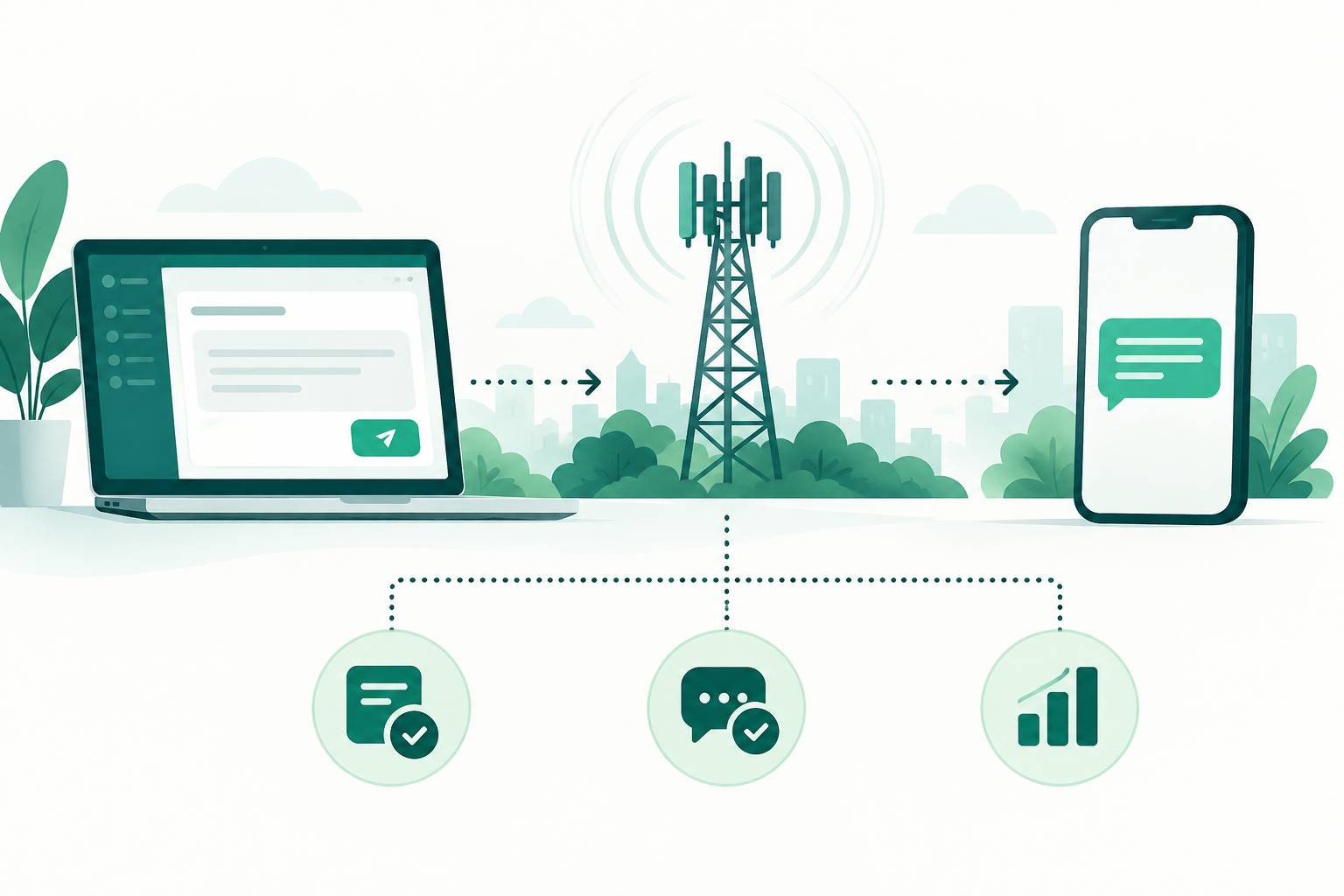
A confirmation can refer to different things
In an A2P SMS flow, “accepted,” “delivered,” and “operation completed” are not synonyms. Each status represents different evidence and comes from a different part of the system.
It is useful to separate SMS transport from the business outcome, at a minimum. If they are combined into a single status, a report may present an operation as successful when there is confirmation only that the message was submitted or delivered.
- Acceptance: The platform or API accepts the send request. This does not prove delivery to the recipient.
- Submission to a provider or route: Records that the message was passed to the next component. This alone is not equivalent to a DLR.
- DLR: A subsequent signal reporting the SMS status according to the service and route used.
- Receipt or reading by a person: This should not be automatically inferred from a DLR.
- Business outcome: The application confirms that the intended goal was completed, such as an OTP being validated.

What a DLR proves—and what it does not
A DLR is a message status signal. Depending on the service, it may indicate that the SMS was delivered, rejected, or expired. Interpret it in accordance with the definition provided by the supplier for that route.
A DLR alone does not prove that a person saw or read the message, received the code in a usable form, or completed the intended action. Acceptance of the send request does not prove delivery either.
Do not assume that A2P SMS has a universal read receipt or that a DLR is an independent check of the device. If the technical meaning of the status is not documented, treat it as a signal reported by the service and make that limitation clear.
- Check the definition of each status and the source of the signal.
- Separate terminal statuses reported by the provider from outcomes observed by your application.
- Do not label a message “read” or an “action completed” based solely on a DLR.

Correlate the message with the transaction without conflating identifiers
To reconstruct a case, you need to be able to relate the business request to the send and its subsequent events. Do not assume a universal identifier scheme: names, formats, and guarantees depend on the relevant interfaces and documentation.
Design an explicit internal correlation method. Assign a transaction identifier in the application and, when available, record the message identifier assigned by the platform and the provider identifier. Keep the relationships between them in a controlled record.
Avoid including the OTP or personal data in identifiers, callback URLs, or logs that do not need them. Verify which fields each interface returns, and document what to do when an identifier is missing or does not match.
- Generate an opaque, unique transaction identifier for the business flow.
- Record identifiers assigned by the platform and provider separately.
- Link events using documented references, not approximate matches based on phone number and time.
- Restrict access to contact details and message content.
Model transport, OTP, and action as separate statuses
Maintain a transport status and a business status rather than combining both into a single field such as “success.” A simple structure can include the send status, the latest known DLR, and the transaction outcome in the application.
For OTP, the application is the component that can confirm that the submitted code was validated according to its rules. The DLR may provide context about the message, but it does not replace validation. For a notification, record the SMS status separately from any business confirmation that the product actually observes.
Define the allowed transitions and closure criteria for each flow. For example, an OTP transaction may close when the application records validation, expiration, or cancellation, while the transport status retains its own outcome. Time limits and closure rules should be set according to the service design, not attributed to a universal standard.
- Transport: pending, accepted, with a reported DLR status, or with no confirmation available.
- Business: pending, completed, expired, or canceled, depending on the events the application can verify.
- Close each dimension separately and retain the event that justifies closure.
- Explain in the interface which system generated each status.
Missing, duplicate, and late events: preserve uncertainty
A DLR that does not arrive does not, by itself, prove that the message failed or succeeded. Similarly, a late event should not silently rewrite a business outcome that has already been recorded.
Implement an event log that retains the time received, available reference, reported status, and source. Deduplicate only according to rules supported by interface documentation or reliable identifiers; there is no universal event deduplication or ordering rule that can be assumed for every provider.
If contradictory statuses arrive, do not resolve them through hidden inference. Preserve the sequence and apply an explicit, reviewable, documented policy. Show “no confirmation available” when that is the evidence you actually have.
- Distinguish a missing signal from a failure signal.
- Record late events without automatically turning them into business success.
- Document the policy for duplicate and contradictory statuses for each interface.
- Set operational waiting and escalation windows for your service without presenting them as universal technical limits.
Useful metrics for OTP and transactional notifications
A reliable metric states exactly what it counts. For OTP, the validation rate belongs to the application flow; the rate of reported DLR statuses belongs to transport. Do not use one to claim the other.
For transactional notifications, report accepted requests, messages with an available DLR, and observable business outcomes separately. State the period, denominator, and how cases without confirmation are handled so the figure can be interpreted.
These breakdowns help pinpoint where to investigate: a gap between acceptance and DLR indicates that transport and route documentation are worth reviewing; a gap between DLR and OTP validation also calls for a review of the product flow, without automatically concluding that the SMS did not arrive.
- Accepted requests / submitted requests.
- Messages with a reported DLR / messages sent, specifying cases with no status.
- Validated OTPs / validation attempts initiated, with a clear definition of an attempt.
- Completed transactions / transactions initiated, according to the verifiable application event.
Privacy, retention, and evidence audits
Records that help investigate a message submission may contain personal or sensitive information, especially in OTP flows. Collect only the fields needed for operations, support, and auditing, and limit who can access them.
Define retention and deletion policies that align with applicable obligations and the service’s justified needs. Avoid storing OTP codes in operational logs unless that is necessary for the designed purpose and controls.
For an audit to be useful, retain the source of each event, its timestamps, and the available correlation links. Do not present a provider signal as independent verification if you cannot substantiate that level of checking.
- Minimize the recipient and message content data recorded.
- Separate permissions for operations, support, and auditing.
- Document retention, deletion, and access.
- Preserve the source and stated meaning of statuses.
Checklist for providers and product teams
Before publishing statuses or metrics, review their semantics with the people operating message delivery and those maintaining the application. Specific capabilities and meanings depend on the documentation for each interface and provider; do not assume them if they have not been confirmed.
Precise terminology avoids implied promises: “accepted by the API” describes a send response; “DLR reported” describes a transport signal; “OTP validated” describes an outcome observed by the application.
- What does each status code mean, and who generates it?
- Which identifiers are returned, and how are they linked to the transaction?
- What evidence supports a DLR, and what limitations does the provider state?
- How are missing, late, duplicate, or contradictory statuses handled?
- Which application event closes the OTP flow or notification?
- Do the metrics distinguish transport, validation, and business action?
- Do logs minimize data, and is there an access and retention policy?
Frequently asked questions
Does a DLR confirm that the user received the SMS?
A DLR reports the message status according to the service and route. It should not automatically be presented as independent proof that a person received or read the message, or took action.
Does a positive DLR prove that the OTP was validated?
No. The application must confirm validation through the outcome of its OTP flow. The DLR and validation are different forms of evidence.
What does it mean if a DLR has not arrived?
It means that your system does not have that confirmation. On its own, this proves neither success nor failure of the send; check the provider’s documentation and communicate the uncertainty.
Is there a universal rule for identifying and deduplicating DLRs?
Do not assume there is. Review the interface documentation and available identifiers, and define an explicit policy for repeated, late, or contradictory events.
What status should be shown to the user?
Show the status you can substantiate—for example, request accepted, SMS status reported, or transaction completed by the application. Avoid calling a signal “delivered,” “read,” or “completed” if it does not prove that outcome.
Sources consulted
- 3GPP specifications index3GPP
- ITU-T Recommendation E.164International Telecommunication Union
- GSMA network resourcesGSMA
- Servicios de Mensajería SMS para EmpresasTelefónica Empresas
- Envía y recibe recibos de mensajesGoogle for Developers