Intermittent A2P SMS Blocks: A Guide to Diagnosing Without Guesswork
A single rejection does not, by itself, reveal where an SMS was interrupted. Learn to distinguish observations from hypotheses and consult the documentation for the system responsible.
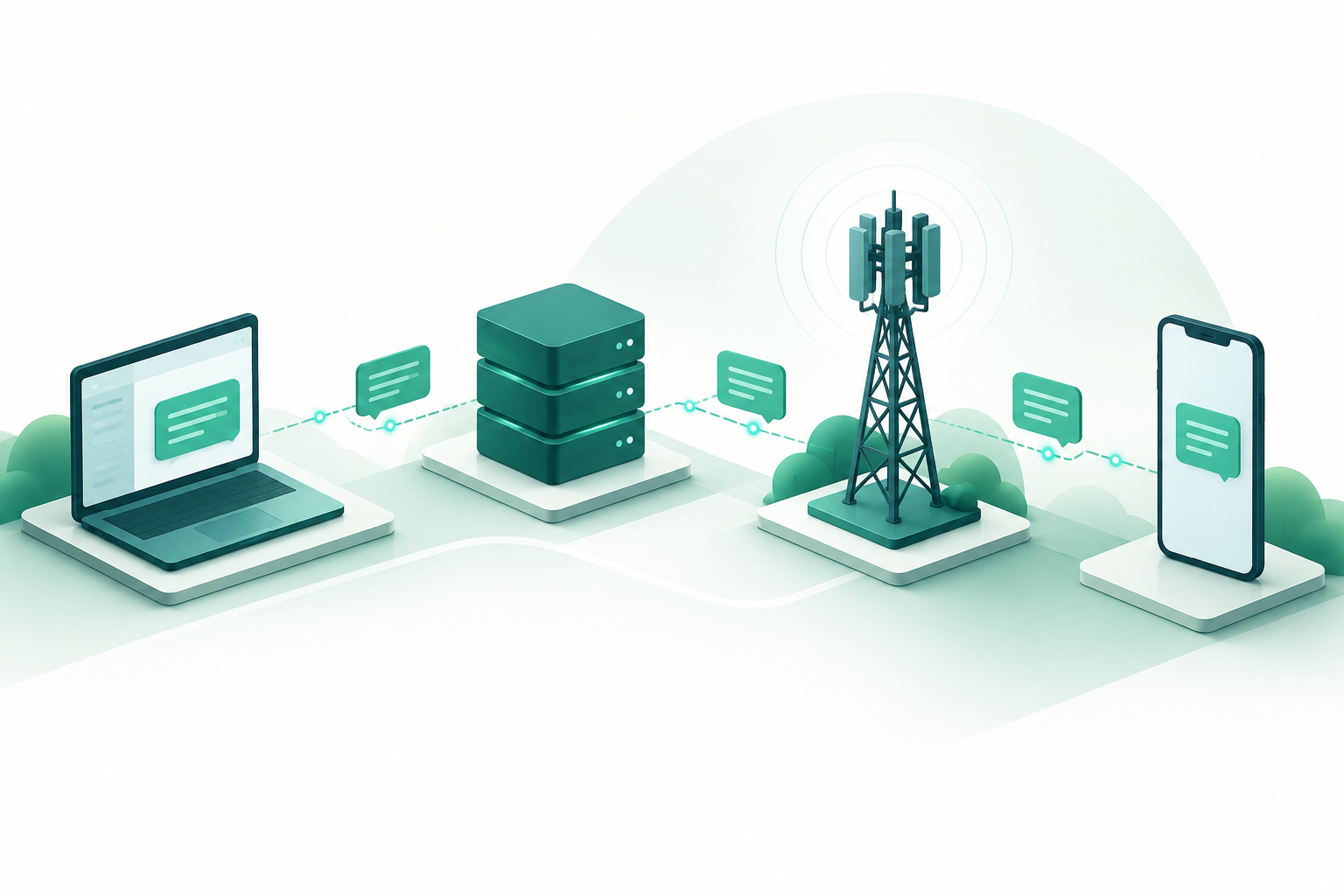
What an intermittent block means
In an A2P SMS operation, “intermittent” describes an observed pattern: some messages appear to progress while others do not, even when they belong to a related flow. The term does not identify the cause. The supplied evidence does not include primary documentation of error codes, delivery statuses, correlated logs, or procedures that would determine at which stage a message was interrupted.
A single rejection is also insufficient to identify the cause. To interpret it, consult the technical documentation for the system that generated the response, and avoid turning a possible explanation—such as filtering, a destination restriction, or a transport failure—into an unsupported conclusion.
- Observation: the result seen or recorded, without attributing an unconfirmed cause.
- Hypothesis: a possible explanation that requires additional evidence.
- Conclusion: an interpretation supported by documentation or technical evidence from the responsible system.

Carefully define the pattern
Destination, operator, sender, content, traffic type, time period, and route may be dimensions to examine when reviewing cases, but the supplied evidence does not validate a matrix or method for determining which one explains a pattern. Record what you observed and avoid presenting an association as a confirmed cause.
ITU-T Recommendation E.164 is provided as an official reference for international numbering. The available material does not detail its application to destination normalization or A2P SMS block diagnosis, so it does not support specific rules for this task.
- Do not assume that any particular dimension identifies the cause.
- Do not infer the destination operator from the symptom.
- Consult the applicable documentation before interpreting numbering or destination data.

Do not confuse the sending stages
A request, an API or SMPP connection response, subsequent statuses, and receipt on a device are distinct concepts. The supplied evidence does not establish a reproducible procedure for separating these stages or determining where a message was interrupted. To interpret a response or status, consult the documentation for the system that generated it.
The meaning of a DLR depends on the documentation for the sending system. Without that documentation, do not infer what a specific status proves or treat it as independent confirmation of receipt on the phone.
- Do not treat a sending response, a reported status, and receipt observed on the device as equivalent signals.
- Consult the sending system’s documentation before interpreting a DLR.
- Do not present a status as proof of physical receipt without appropriate verification.
Keep hypotheses as hypotheses
Filtering, restrictions applicable to the destination, sender configuration or authorization, content, connectivity, and route may be raised as possible lines of inquiry. The supplied evidence does not establish that any of them is present in a specific case.
If a response points to a category of problem, check it against the authorized technical documentation for the responsible system. The available material does not provide a reliable catalog of codes or responses or universal guidance for confirming them.
- Do not interpret a rejection as proof of filtering.
- Do not attribute a problem to the sender, content, connectivity, or route without technical support.
- Contact the provider or system that generated the response when its meaning is not documented.
Comparing cases does not prove causation
Different outcomes for two messages may raise questions, but they do not prove which variable caused the difference. The supplied evidence does not validate a comparison design, controlled tests, success criteria, or observation windows applicable across all systems and networks.
Do not present changes to content, sender, route, or other parameters as a proven method for diagnosing blocks. All messaging activity must be legitimate, authorized, and compliant with applicable rules; it must not be intended to evade filters or regulatory controls.
- A difference between cases does not, on its own, confirm a cause.
- Consult the system’s responsible party before interpreting comparison results.
- Do not make changes to evade filters or regulatory controls.
Consulting statuses and logs
The supplied evidence does not include primary documentation of error codes, delivery statuses, or correlated logs. Therefore, it does not support a reliable code catalog or establish how to link events across systems.
Consult the documentation for the system that generated each response or status. Do not interpret unknown codes by intuition or treat the absence of a log as definitive proof that a particular stage failed.
- Verify code meanings in the sending system’s documentation.
- Do not assume that statuses from different systems share an interpretation without supporting evidence.
- The absence of an event does not, by itself, prove where the message was interrupted.
Responsible escalation
The supplied evidence does not validate an escalation format or a universal set of fields. When contacting the provider or system owner, request the relevant documentation for interpreting the responses and statuses observed, and follow their instructions about the information they need.
Protect personal data and do not expose credentials. Share only the information needed, in accordance with applicable policies and through authorized channels.
- Do not present a template or correlated sample as a universally validated method.
- Ask the system owner what information they need to review the case.
- Minimize personal data and do not share credentials.
Changes and verification require support
The supplied sources do not establish guidance for controlled changes, verification criteria, or procedures for preserving evidence during an investigation. Consult the applicable documentation and the system owner before treating a change as proof of a cause.
Do not change parameters to avoid filters, regulatory controls, or destination restrictions. All messaging activity must be legitimate and comply with applicable rules.
- The available evidence does not define universal verification criteria or time windows.
- Do not present a change as proof of a cause without technical support.
- Do not attempt to evade filters, regulatory controls, or destination restrictions.
Frequently asked questions
Does a single rejection prove that an A2P SMS was filtered?
No. A single rejection does not, by itself, identify the cause. Consult the documentation for the system that generated the response; the supplied evidence does not include enough information to interpret specific codes or responses.
Does API or SMPP acceptance confirm that the recipient received the message?
It should not be treated as confirmation of receipt on the device. The supplied evidence does not establish a reproducible procedure for separating the sending stages.
Does a DLR prove that the message reached the phone?
The meaning of a DLR depends on the sending system’s documentation. Without it, do not claim what a specific status proves or treat it as independent verification of physical receipt.
What information should I send when escalating the issue?
The supplied evidence does not validate a universal format or set of fields for escalation. Ask the system owner what they need, protect personal data, and do not share credentials.
Should I change the message text to check whether it is being blocked?
The available evidence does not establish a controlled testing method or verification criteria. Do not make changes with the aim of evading filters or regulatory controls; all activity must comply with applicable rules.
Sources consulted
- 3GPP specifications3GPP
- ITU-T E.164International Telecommunication Union
- GSMA resourcesGSMA
- Estudio del servicio de mensajes cortos: aplicación a personaInstituto Federal de Telecomunicaciones (IFT)