End-to-End Latency in A2P SMS: Defining Milestones and Comparing Timings
An operational guide to ordering timestamps by stage, correlating events, and comparing latency without confusing processing, network time, DLRs, and receipt on the device.

Latency Is Not a Single Interval
An A2P route involves several systems: the sending application, the submission interface, a gateway or messaging platform, one or more providers, and the mobile network. A measurement called “end-to-end latency” is only interpretable if its start and end points are specified and the event represented by each timestamp is clear.
It is useful to distinguish the observed delay between milestones from deliverability. The former describes an interval based on available records; the latter concerns the delivery outcome according to the evidence and agreed semantics. A latency value alone does not prove that the message reached the recipient.
- Define each interval by its start event, end event, source of both timestamps, and unit.
- Do not compare a measurement that starts when a message is created with one that starts when the provider accepts it.
- Do not set a universal threshold without knowing the use case, route, destination, and event being measured.
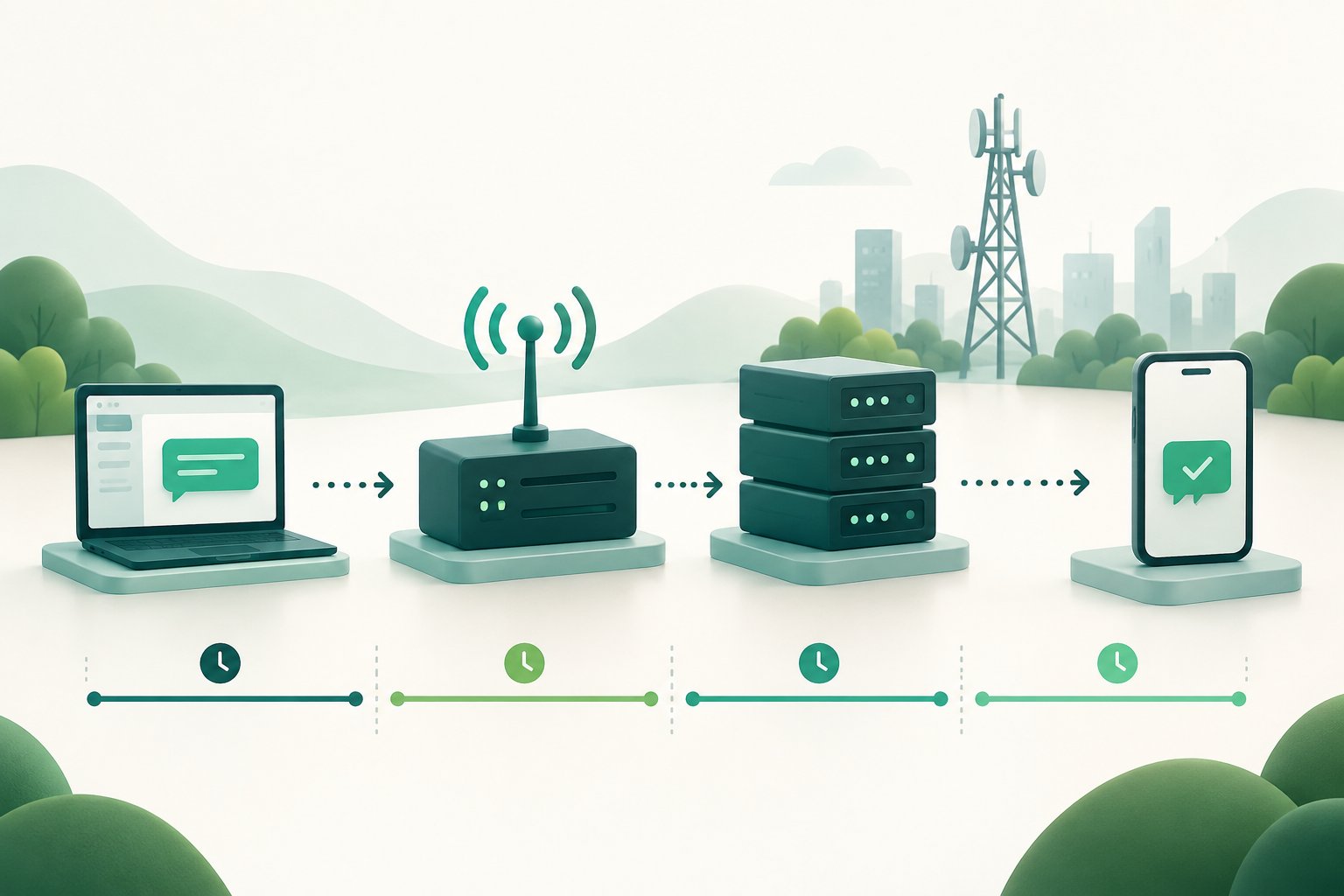
Inventory Milestones Before Calculating
Start by collecting the events each component actually records. The application may have a creation timestamp and a submission timestamp; the HTTP or SMPP interface may return an acceptance or rejection response; the provider may record receipt, queuing, or forwarding; and status reports may appear later. The availability and exact meaning of each event depend on the implementation, applicable specification, and provider profile or contract.
Do not assume a field has the same semantics across all systems. For each timestamp, record who generated it, which transition it represents, whether it is event time or record-receipt time, its precision, and its time zone. If the documentation does not clarify this, label the semantics as unknown and do not use it as an endpoint for a conclusive comparison.
- Create an inventory with the event name, source system, definition, format, time zone, and precision.
- Separate the event timestamp from the time another system received or stored that event.
- Consult the technical specification and the provider’s contractual documentation before interpreting responses and notifications.
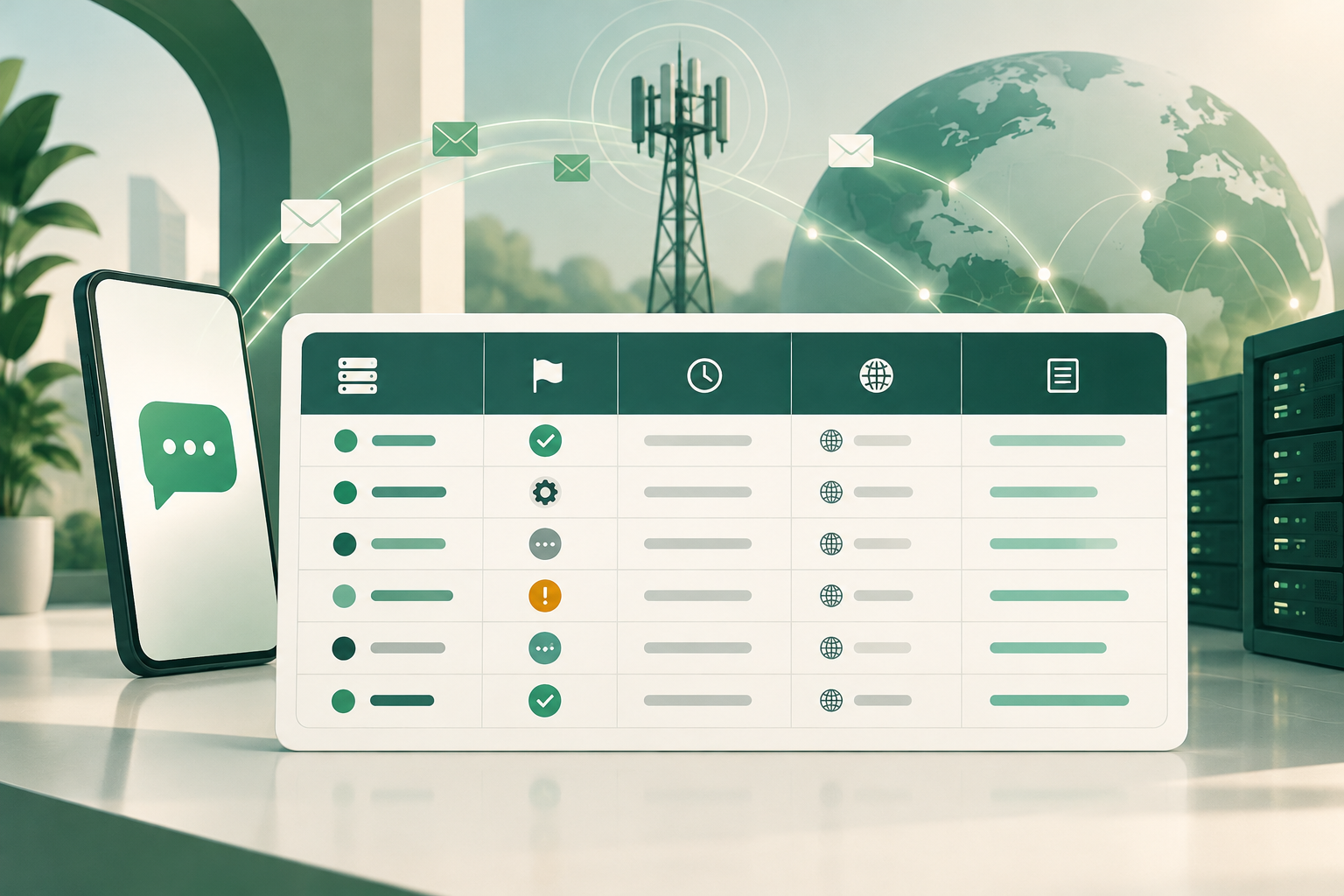
Correlate Records by Message
Each submission needs a correlation key that can be followed across systems to reconstruct its sequence. Use the identifier returned by each interface when available, and document how it maps to the internal identifiers used by the gateway, provider, and status reports. If a component replaces an identifier, explicitly preserve the relationship between the incoming and outgoing values.
Do not assume an identifier is globally unique or retained throughout the entire route. Check its scope, retention period, and reuse rules. Avoid correlating only by destination number and proximity in time: under concurrent traffic, that combination can associate events with the wrong message.
- Maintain a mapping of identifiers across systems.
- Validate correlation using end-to-end traceable samples and flag ambiguous matches.
- Apply access controls and data minimization when retaining identifiers and messaging data.
Separate Admission, Queuing, and Notification
An admission response indicates the outcome of an interaction with an interface according to its documented semantics; it does not automatically mean acceptance by the entire chain or delivery to the phone. Likewise, the time between admission and forwarding may include processing or queuing by the system that records it, while the interval until a notification also includes the steps needed to produce and return that event.
Build separate metrics for each segment you can observe using comparable timestamps. For example, measure separately the time from application submission to the interface response, from documented acceptance to the next verifiable event, and from that event to receipt of a notification in your platform. Do not attribute the entire interval to the mobile network if the records cannot isolate that portion.
- Name metrics after their exact milestones rather than using generic labels such as “SMS latency.”
- Distinguish processing, queueing, and time between systems only when there are enough events to do so.
- A DLR is a status notification whose interpretation depends on the specification and provider; do not present it by itself as independent proof of receipt on the device.
Check Clocks and Time Semantics
Subtracting timestamps from different systems can be misleading if their clocks are not synchronized. Before calculating intervals across components, find out how their clocks are synchronized, how much offset is permitted, and whether the recorded time refers to the event or to ingestion. If the offset cannot be determined, state that the comparison is approximate or limit it to milestones recorded by the same clock.
Normalize timestamp representations to a common convention, but retain the original values and source time zone. Converting a format does not correct a clock that is running behind; nor does the apparent precision of a timestamp guarantee that the measurement is that accurate.
- Document the time zone, resolution, known synchronization, and possible offset for each system.
- Investigate negative or implausible intervals as possible clock, correlation, or semantics issues; do not automatically convert them to zero.
- Report precision limits and any corrections applied, along with the method and assumptions.
Compare Cohorts and Distributions
A single average can hide variability and combine different populations. For comparisons, create cohorts with the same message type, milestone definitions, destination or destination group, sender, and relevant time window. Calculate the same measures on matched observations and report the sample size and period covered.
Use a distribution and percentiles to describe observed performance, but explain which messages are included and which are excluded. Do not compare a percentile from a complete cohort with one calculated only from messages for which a notification was received: the inclusion rule changes what the result means.
- Set the interval endpoints and inclusion rules before analysis.
- Show the number of observations, time window, selected percentiles, and exclusions.
- Compare equivalent cohorts; if destination, route, or traffic type differs, note that difference rather than attributing it to a single cause.
Handle Missing Events and Incomplete Observations
If no status notification arrives during the observation window, that fact does not reveal the delivery time or an exact delay. The event may be missing, delayed, unavailable in the data stream, or absent for another reason that the records cannot distinguish. Classify the case as incomplete or as having no event observed, according to your rules, rather than assigning it an invented latency.
Document the observation window and the policy for messages still pending when the analysis closes. Keep measurable intervals separate from censored or pending observations and cases without reliable correlation. This prevents a sample consisting only of complete events from being treated as representative of all submissions.
- Define when a submission is considered pending or to have no event observed.
- Report separately messages with a calculable interval, incomplete messages, uncorrelated messages, and exclusions.
- Do not impute a delivery time from a missing DLR or automatically treat its absence as proof of failure.
Use Segments to Investigate, Not to Pass Judgment
Segmenting by destination, operator, sender, traffic type, or route can help identify where to investigate. For a useful comparison, keep milestones consistent and check that cohorts have comparable periods and conditions. Segmentation reveals associations in the available data; on its own, it does not prove which component caused a delay.
A practical analysis flow is: validate correlation, review clocks and semantics, build the intervals, classify missing data, compare equivalent cohorts, and check findings against each participant’s records. If an intermediate timestamp is missing, present the result as an aggregate interval and avoid assigning its duration to a specific stage.
- Start with a clearly defined issue and choose a segmentation that can help test it.
- Look for evidence in the systems involved before attributing a cause to a route, operator, or provider.
- Keep a versioned definition of metrics so instrumentation changes are not mistaken for performance changes.
Frequently asked questions
What does it mean to measure end-to-end latency in A2P SMS?
It means measuring an interval between two defined milestones in a messaging chain. The term is useful only when the start and end events, the systems that generate their timestamps, and the semantics of each timestamp are specified.
Does a DLR prove that an SMS was received on the phone?
Do not assume so. A DLR is a status notification, and its scope depends on the applicable specification and provider. Without additional evidence, it is not equivalent to independent verification of receipt on the device.
How do you compare timestamps from different providers?
First verify correlation, event definitions, time zones, precision, and clock synchronization. If the offset is unknown, limit the comparison to events from the same clock or state the uncertainty explicitly.
What should you do if a status notification is missing?
Classify the message as incomplete, pending, or having no event observed according to a documented observation window and set of rules. Its absence does not provide an exact duration or automatically show that the message failed.
Which statistics should you report?
Use distributions or percentiles for comparable cohorts and accompany results with the sample size, period, milestone definitions, and exclusions. Do not mix complete messages with pending observations without explaining the difference.
Sources consulted
- 3GPP specifications by series3GPP
- ITU-T Recommendation E.164International Telecommunication Union
- GSMA Networks resourcesGSMA
- XVI Jornadas de Ingeniería Telemática (JITEL 2023) proceedingsJITEL / Universitat Politècnica de Catalunya