A2P SMS Usage Reconciliation: Linking Traffic, Statuses, and Charges
A guide to organizing SMS reconciliation across your platform, provider, and billing system; separating events from billable units; and documenting discrepancies without claiming that a DLR proves more than it does.
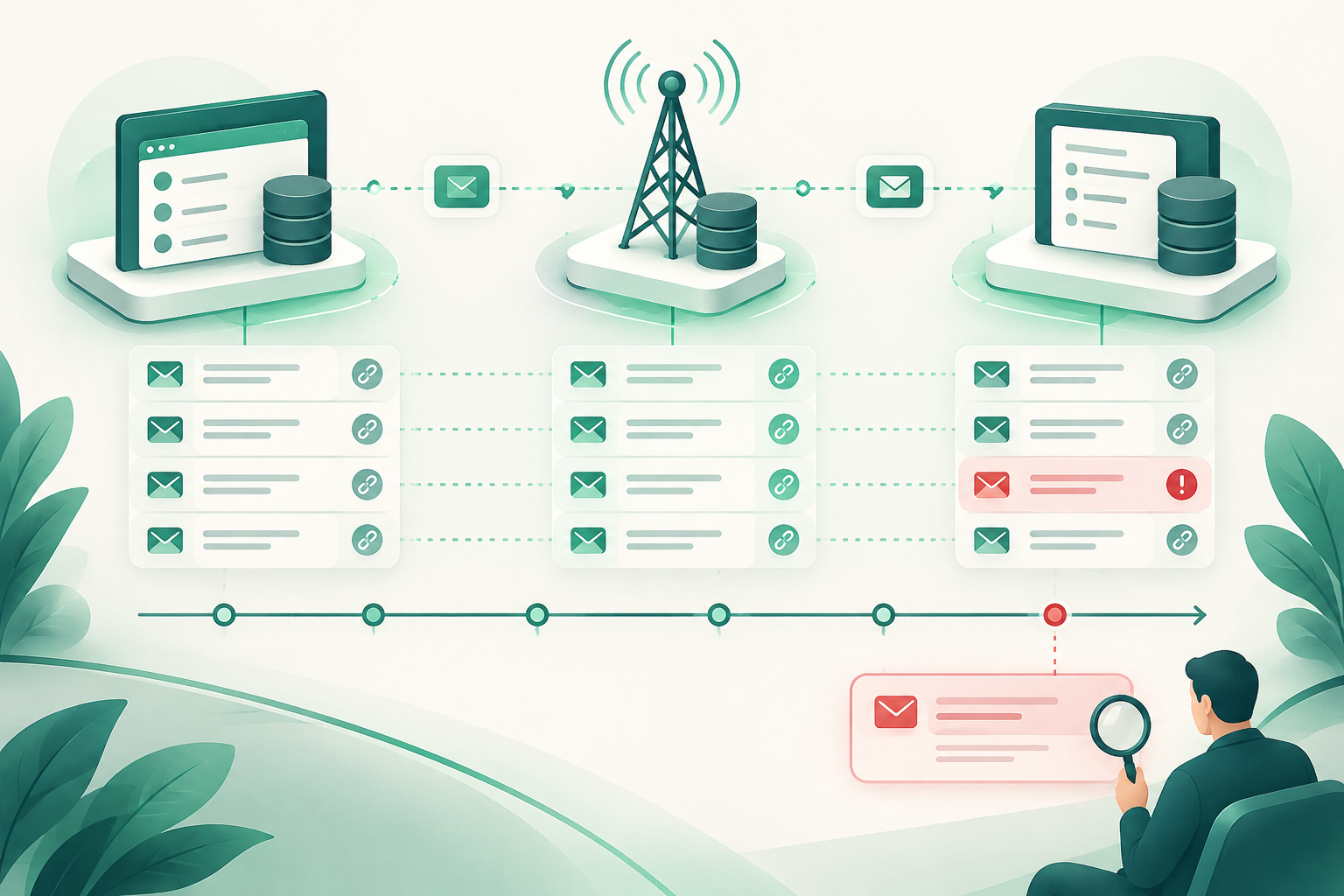
Define what you are reconciling before comparing figures
Reconciliation is not simply a matter of comparing the message totals in two reports. First, define what each record represents and which unit is being compared. A platform may record incoming requests; a provider may record messages accepted or processed; and a billing system may calculate billable units under the applicable terms. These sets may not be equivalent.
At a minimum, separate sending events, reported delivery statuses, and billed units. A message may relate to more than one event or segment, depending on the implementation and commercial rules. Do not assume that a request equals a message, that a message equals a segment, or that a delivery status determines the charge.
- Requests: submissions received or attempted by the platform.
- Acceptances: records indicating that a system accepted a message for processing, according to that system’s definition.
- Segments: transmission units that may differ in number from requests or messages. Confirm how each party defines them.
- DLRs: status reports associated with traffic. A reported DLR does not, by itself, prove independent receipt on the phone or establish which unit should be billed.
- Billable units: the unit and charging rule specified in the applicable agreement or billing document.

Agree on identifiers and correlation keys
To link records across different systems, agree on which identifiers will be retained and how they will be interpreted. Do not assume that an identifier generated by one platform will appear unchanged in the provider’s records or on the invoice. If there is no shared key, document which combined fields will be used to find matches and label the result as a probable match, not a verified link.
Before the reconciliation cycle, agree in writing on field names, which system generates them, their scope, and how long they are retained. Protect personal data and limit access to information needed for the investigation.
- Where available, record the request identifier and identifiers assigned by each system.
- Retain reference fields that help locate traffic, such as destination, sender, route, or account, where they exist and their use is authorized.
- Do not link records solely because their destination and timestamp match: several similar messages may fall within the same interval.
- Preserve the relationship between an original record and any derived identifier, and document the transformation rule.
- If there is no shared key, ask the provider for the reference field or level of detail needed to verify the match.

Normalize without overwriting source data
Comparison requires compatible formats, but normalization does not mean erasing the original evidence. Preserve each received record as it arrived, and create separate normalized fields with the applied rule noted. This makes it possible to reproduce the comparison and identify whether a discrepancy resulted from the transformation.
Agree on the cutoff period and time zone before totaling records. If parties define the interval differently, events may shift between cycles. The available evidence does not establish a universal convention for these processes: the parties must set the rule together and check it against the contract and each system’s formats.
Apply the same caution to destinations, units, and statuses. Do not convert number formats, status labels, or billable units using an assumed rule. For destinations, use the agreed convention and document transformations. ITU-T Recommendation E.164 is an authoritative numbering reference, but it does not by itself define the reconciliation procedure or commercial terms.
- Preserve the original date and time, the declared time zone, and the normalized date used in the analysis.
- Define cycle boundaries, whether endpoints are inclusive, and how late or corrected records are handled.
- Note any changes to destination, sender, unit, or status formats, and keep the original value visible.
- Document the version of the normalization rule and who approved it.
- If a file’s time zone or unit is unknown, do not infer it silently: request clarification and leave the batch pending.
Classify discrepancies by type
A difference in totals does not, by itself, show where the problem lies. Break the analysis into categories so each has a verifiable question and appropriate evidence. Keep disagreements about volume separate from disagreements about status or rates.
Categories help prevent premature conclusions. For example, a difference between the platform’s status and the provider’s status does not prove that a charge is incorrect. Likewise, a difference in units may stem from definitions that need to be checked against the commercial rules.
- Volume: records present in one system but missing from another, or totals that do not match.
- Status: differences between reported statuses and their associated timestamps.
- Destination or sender: missing, different, or transformed values.
- Billable unit: discrepancies between messages, segments, or another unit defined in the agreement.
- Period: records assigned to different cycles because of cutoffs, time zones, or late arrival.
- Price or commercial rule: differences between the calculated charge and the applicable billing document.
Investigate using linked traces, not assumptions
Select a small set of representative cases and follow each record from the platform to the provider and the corresponding billing line. At each step, note the observed identifier, source, timestamp, applied transformation, and whether the link was verified or only inferred.
Treat DLRs as evidence of a status reported by the system that provides them. Do not automatically treat a DLR as proof of receipt on the handset or use it as a conclusion about billing. The relationship between status and charge depends on the applicable technical and commercial definitions, which must be checked in the parties’ documentation.
If a trace cannot distinguish between several possible matches, preserve that uncertainty. Request the supplementary record or the provider’s explanation rather than attributing causality to a route, operator, or event.
- Select cases with complete identifiers, as well as cases that represent the discrepancy under investigation.
- Compare equivalent fields, not just columns with similar names.
- Record the link between each event and the billed unit, indicating the supporting evidence.
- Document unverified matches as hypotheses, not facts.
- Do not attribute a discrepancy to a delivery failure or provider until there is sufficient evidence.
Classify outcomes and assign owners
When closing a review, use categories that distinguish a supported explanation from an issue that remains open. The label should describe the state of the evidence, not prejudge who is right. Assign an owner and a next action to every pending or disputed difference.
A simple, agreed classification reduces the risk that a provisional observation becomes an accounting adjustment without approval. Link each decision to the records reviewed and the rule applied.
- Explained: an agreed rule or evidence accounts for the difference; record the supporting reference.
- Pending: data, a definition, or a response is missing; state who should provide it and by when, according to the internal process.
- Disputed: the parties maintain different interpretations; retain both positions and the available evidence until the issue is resolved.
- Unverified: the match or transformation could not be checked; do not present it as a complete reconciliation.
- Adjusted: if an adjustment is made, record the affected amount or unit, approval, reason, and link to the original discrepancy.
Leave a reproducible audit trail
Reconciliation should allow another person to reconstruct what was compared, which rules were used, and what remains unresolved. Retain source files, the period, normalized versions, agreed rules, results, and communications supporting decisions, in line with the organization’s retention and security policies.
Do not overwrite closed cycles without leaving a record. If a corrected file arrives or a definition changes, preserve the previous version, identify the change, and document whether it affects previous conclusions or adjustments.
- Identify the sources, extraction dates, reconciled cycle, and owners.
- Preserve originals and transformations with appropriate access controls.
- Record filters, normalization rules, matching criteria, and exceptions.
- Link each discrepancy to its evidence, decision, approval, and next action.
- Note verification limits, such as missing identifiers or formats whose meaning has not been confirmed.
Checklist for the next cycle
Before starting, confirm that the parties share the necessary definitions and that the data makes it possible to trace events through to charges. If a critical condition is unresolved, define which part of the cycle can be reconciled and which must remain pending.
Reconciliation is stronger when rules are agreed before discrepancies are reviewed. If systems, formats, or commercial terms change, review the procedure and record the cycle from which the change applies.
- Is the meaning of each total defined: request, acceptance, segment, status, or billable unit?
- Have correlation identifiers been agreed, along with what to do when they are missing?
- Have the cutoff period, time zone, and handling of late records been set?
- Are original data retained alongside normalized versions?
- Are the rules for destinations, senders, statuses, and units documented and confirmed?
- Does each discrepancy have a category, owner, required evidence, and next action?
- Are reported DLRs distinguished from verified receipt and from the charging rule?
- Are adjustments, approvals, and verification limits recorded?
Frequently asked questions
Does a DLR confirm that the message was received on the phone?
Not necessarily. A DLR is a status report provided by a system. By itself, it is not equivalent to independent verification of receipt on the handset, nor does it automatically determine whether a charge applies.
Can I use the destination number and time to link records?
They can help with an investigation, but they may not be enough to prove that two records relate to the same message. If there is more than one possible match, mark the link as unverified and request identifiers or additional evidence.
Which time zone should be used for the cutoff?
No universal convention for all agreements and systems is established here. The parties should define the time zone, document period boundaries, and retain original timestamps so the comparison can be reproduced.
How should a difference between messages and billed units be resolved?
First confirm which unit each record defines and which unit the commercial agreement specifies. Then link billed units to the available traffic evidence. Do not assume that a request, message, segment, and billable unit are equivalent.
What should we do if the systems do not share an identifier?
Agree on an alternative key and document its limitations. If matching depends on several fields, record the rule used and distinguish verified matches from probable ones. For a conclusive reconciliation, request the additional detail needed to verify the link.
Sources consulted
- 3GPP specifications3GPP
- ITU-T E.164International Telecommunication Union
- GSMA resourcesGSMA