How to Apply Change Control to A2P SMS Routes: Approvals, Evidence, and Rollback
An operational guide to documenting, approving, testing, deploying, and rolling back changes to A2P SMS routes without confusing commercial claims with observed technical evidence.

What counts as an A2P route change and why it should be treated as an operational change
An A2P SMS route should be managed as an operational configuration item. It is not limited to replacing a provider: it also includes changes to interconnection, selection priority, destination, numbering scope, permitted senders, traffic restrictions, applicable conditions, or rules that may alter service behavior.
The purpose of change control is not to slow down routing. It is to ensure that every modification has an owner, a known baseline, an authorized decision, a way to verify its effect, and a return path. This approach makes it possible to explain what changed, why it was done, and what happened afterward.
Describing the scope only as a country or a commercial route is often insufficient. The specific technical scope should be recorded: country, prefix, network where known, numbering type, sender, authorized traffic type, and affected cohort. For expressing the destination, an international numbering format aligned with E.164 helps reduce ambiguity.
- Change of provider or interconnection for a specific destination.
- Change of priority, weight, or selection rule between routes.
- Modification of sender ID, permitted origin, or sender presentation policy.
- Change to restrictions by traffic type, authorized content, numbering, or volume.
- Modification of conditions that may affect DLRs, latency, availability, or operational capacity.
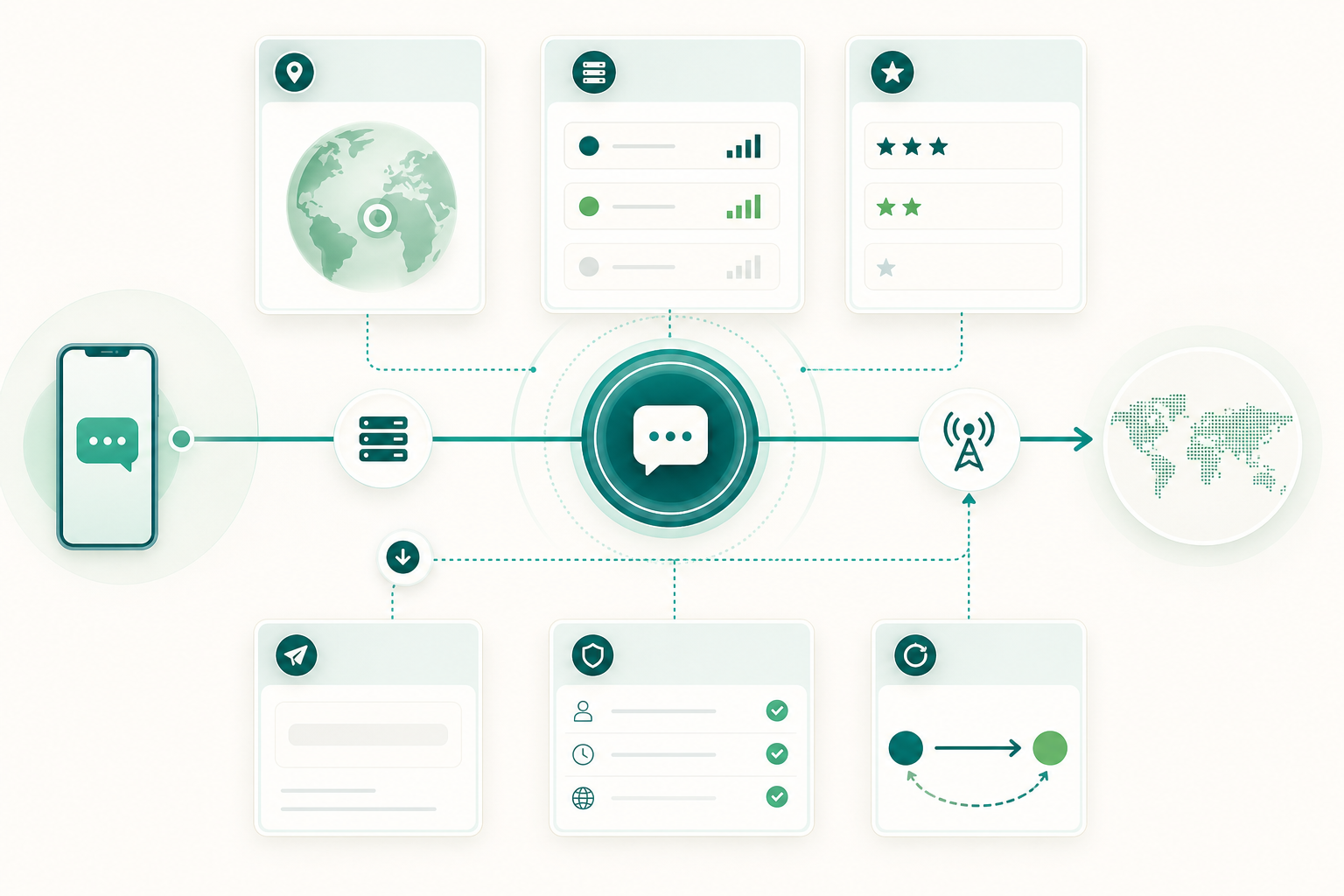
Risks a change can introduce
An apparently small change can alter several properties at once. For example, a priority adjustment may change the effective provider, sender handling, acceptance speed, available status codes, or exposure to destination restrictions.
The assessment should not begin from the assumption that a commercial claim is equivalent to a technical outcome. Conditions communicated by a provider are useful information for designing a test, but they must remain distinct from what is observed in test traffic and in operation.
A compliance review should also take place when the change affects the sender, who transmits the messages, or the enforcement of traffic policies. Messages used in testing must be legitimate, authorized, and compliant with applicable rules. In the United States, TCPA restrictions on robotexts make it especially important to review the consent basis and campaign context.
- Different traffic classification or application of unexpected restrictions.
- Alteration of the sender displayed, accepted, or blocked.
- Differences in statuses, error codes, or DLR consistency.
- Increased latency caused by queues, processing, or downstream network behavior.
- Insufficient capacity, degraded availability, or concentration on a single point.
- Compliance risks related to sender ID, consent, content, or campaign type.
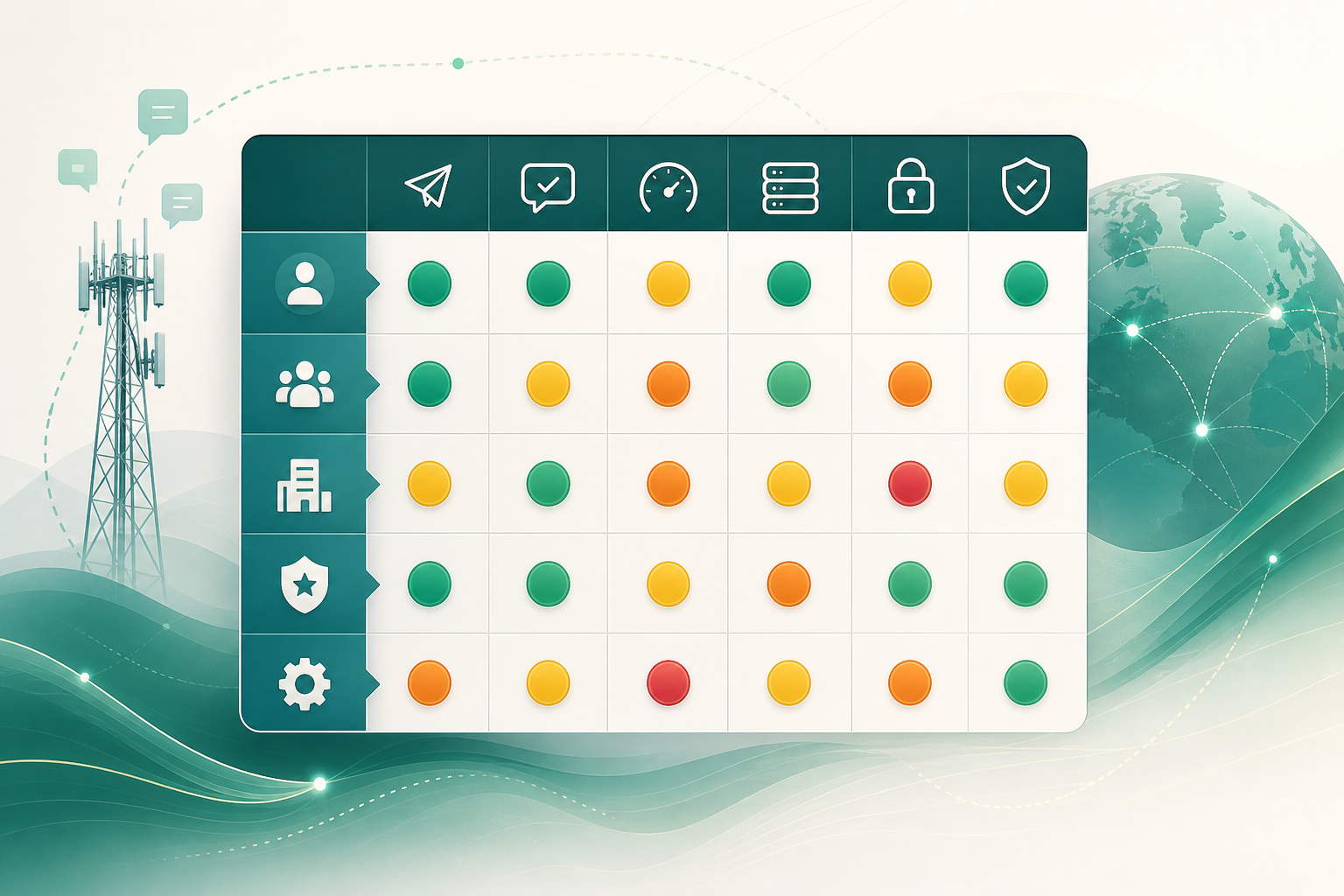
The minimum change record: what must be documented
Every change needs a single, version-controlled record. It should allow someone not involved in the execution to understand the previous configuration, the proposed modification, the business or operational reason, the scope, and the controls applied.
The record should explicitly separate four types of information: observed facts, third-party claims, working assumptions, and internal decisions. This separation prevents an advertised condition from being mistakenly treated as a proven fact.
Evidence must be retained with date and context. A test result without destination, message identifier, time window, applied configuration, and change version is difficult to interpret and even more difficult to compare after an incident.
- Change identifier and record version.
- Baseline configuration: route, provider or interconnection, priority, rules, and scope before the change.
- Proposed change, reason, owner, and effective date or window.
- Destination and technical scope: country, prefix, network, or numbering type where applicable.
- Sender, traffic type, and included or excluded restrictions.
- Provider claims, labeled as such and accompanied by their source or date.
- Available independent evidence: tests, events, DLRs, error codes, and observations.
- Impact analysis, approvals, deployment plan, stop conditions, and rollback.
How to separate facts, claims, assumptions, and decisions
A defensible record avoids ambiguous statements such as “the route supports the destination” or “delivery is confirmed” without specifying the evidence behind them. Instead, each statement should belong to an identifiable category.
Observed facts come from logs and tests: a send response, a received status, a timestamp, an error code, or sender behavior during a defined test. Provider claims describe what a third party states about coverage, connectivity, or conditions. Assumptions indicate what is provisionally considered true for planning purposes. Internal decisions reflect which action is approved and under which limits.
This discipline is essential with DLRs. A submitted or delivered status can be useful for monitoring the lifecycle reported by the messaging chain, but it should not be presented as universal proof of receipt or reading on the handset. The meaning of the status depends on the available confirmation and may not reflect last-mile interruptions or the actual state of the device.
- Observed fact: “During the test window, a specific status and code were received for a message identifier.”
- Third-party claim: “The provider states that it accepts a particular sender for the stated scope.”
- Assumption: “The selected cohort is expected to represent destination behavior, pending validation.”
- Internal decision: “A limited deployment is authorized under these stop conditions and this rollback plan.”
Approval criteria based on criticality
Approval should be proportionate to the potential impact. A practical classification distinguishes standard, normal, and emergency changes. The category should not be defined for convenience, but according to scope, reversibility, compliance sensitivity, and possible effects on customers or critical traffic.
Standard changes are pre-approved only when they are defined in advance, have a repeatable procedure, clear boundaries, and low risk within those boundaries. A change that exceeds the predefined scope is no longer standard and must be reassessed.
Normal changes require impact analysis, authorization before execution, and a post-change review. Emergency changes may follow an expedited path to protect continuity or respond to an incident, but they do not remove the need to document, analyze, and review.
- Standard: predefined procedure, low risk, limited scope, and already approved controls.
- Normal: planned change requiring impact analysis, authorized owners, and prior approval.
- Emergency: expedited action in response to an immediate operational risk, with compensating controls and mandatory post-change review.
Designing the pre-assessment and controlled tests
Before expanding a change, define the question the test must answer. It is not enough to verify that a send request is accepted: it may be necessary to observe final statuses, DLR consistency, latency by stage, errors, availability, and sender or authorized test-content behavior.
The test matrix should represent the scope intended for change. Include the relevant destinations, numbering types, senders, and categories of legitimate traffic. Do not automatically extrapolate the result of a small cohort to all destinations or conditions.
Set explicit exposure limits before starting: maximum volume, duration, cohorts, schedules, senders, test content, and monitoring owner. Keep content legitimate, identifiable, and authorized; do not use testing to evade filters, policies, or applicable requirements.
- Define a baseline configuration for comparison.
- Select a representative sample of the intended technical scope.
- Use legitimate and authorized test messages.
- Record message identifiers, timestamps, statuses, codes, and the applied configuration.
- Separate platform acceptance from subsequent observation in the network.
- Set stop conditions before activating test traffic.
Phased deployment: cohorts, windows, and stop conditions
After an initial assessment, deployment should proceed in stages. The purpose is to limit the blast radius and retain a useful reference for comparing behavior before and after the change. The specific percentage of traffic should not be universal: it should reflect destination criticality, volume, monitoring capacity, and the ease of rollback.
A typical sequence is to activate a limited cohort, observe it during a defined window, review results against the baseline, and decide whether to retain, expand, pause, or roll back. Avoid making independent changes to provider, priority, sender, test content, and restrictions in the same window when doing so prevents attribution of the result to an identifiable cause.
Stop conditions must be actionable. Instead of “stop if there are issues,” specify which signal will be observed, over what window, who has the authority to stop, and what the immediate return mechanism is.
- Start with a limited, clearly identifiable cohort.
- Keep a baseline configuration available for return.
- Define observation windows before each expansion.
- Do not expand if data is missing, results are inconclusive, or a stop condition is triggered.
- Record every decision to advance, pause, or roll back together with its evidence.
Metrics and signals: what to monitor and what not to conclude
Monitoring should combine several signals rather than relying on a single metric. Review the distribution of available statuses, error codes, DLR consistency, availability, sender and authorized test-content behavior, and latency measured across distinct stages.
Platform acceptance or processing latency is not equivalent to downstream latency in the mobile network or receipt on the handset. Therefore, document the start and end event used for each measurement and avoid comparisons between differently defined intervals.
Where raw DLR data is available, retain it together with the received date, message identifier, and applied configuration. Even so, evidence should be interpreted carefully: a DLR or delivered status describes a confirmation available in the delivery chain, not a guarantee of display, reading, or verifiable receipt on the device.
- Message statuses and their distribution by cohort or destination.
- Error codes and changes relative to the baseline.
- Temporal and semantic consistency of available DLRs.
- Segmented latency: acceptance, processing, and observable downstream events.
- Route availability and behavior when errors occur.
- Sender ID and authorized test-content behavior.
Frequently asked questions
Does a delivered DLR prove that the SMS reached the handset?
Not universally. A delivered status or DLR reflects the confirmation available from the messaging chain or operator, but it may have limitations and does not prove reading, display, or the actual state of the handset. It should be interpreted together with the technical context and the provider's definition of the status.
What must be approved before changing an A2P SMS route?
At a minimum, the scope, baseline configuration, proposed change, impact analysis, test plan, exposure limits, stop criteria, rollback mechanism, responsible owners, and implementation window.
When can a route change be considered standard?
Only when it is part of a predefined and pre-approved procedure with low risk, limited scope, and clear controls. If it introduces a provider, destination, sender, restriction, or impact not covered by that procedure, it should be treated as a normal or emergency change as appropriate.
What should a rollback plan contain?
The previous configuration to be restored, the technical return mechanism, the authorized owner who can activate it, the signals that trigger it, the post-rollback verification window, and a record of decisions and incidents.
Sources consulted
- NIST SP 800-128 — Guide for Security-Focused Configuration Management of Information SystemsNational Institute of Standards and Technology (NIST)
- 3GPP TS 23.040 — Technical realization of the Short Message Service (SMS)3rd Generation Partnership Project (3GPP)
- ETSI TS 123 040 V19.0.0 — Technical realization of the Short Message Service (SMS)European Telecommunications Standards Institute (ETSI) / 3GPP
- ITU-T Recommendation E.164 — The international public telecommunication numbering planInternational Telecommunication Union (ITU)
- Outbound Message Status in Status CallbacksTwilio Documentation
- Delivery Receipts in Conversations (classic)Twilio Documentation
- Build to scale: queueing and latency on TwilioTwilio Documentation
- Messages resourceTwilio Documentation
- Federal Communications Commission 24-24 — TCPA consent requirements for robocalls and robotextsFederal Communications Commission (FCC)
- FCC Consumer Guide — One-to-One Consent Rule for TCPA Prior Express Written ConsentFederal Communications Commission (FCC)