A2P SMS Metric Integrity: Identify Changes Before Comparing Routes
Before concluding that a route has improved or worsened, check that the sources, fields, denominators, and time windows are still comparable.

Data integrity comes before any route comparison
A historical comparison is useful only if the periods being compared measure the same thing. An apparent change in delivery, DLRs, or latency may be due to route performance, but it may also result from a different source, a changed definition, a field that stopped arriving, or a denominator calculated differently.
That is why measurement should be validated before deciding whether to shift traffic or renegotiate a route. Define which event counts, which population is included, what period is observed, and which source provides each value. If any of these elements changes, treat the result as a possible comparability break—not as a confirmed improvement or decline.
- Compare periods using the same destination, operator, traffic type, scenario, and time window, where those data are available.
- Separate a change observed in the data from a causal explanation about the route.
- Keep event counts and the rule used to calculate each rate; a rate on its own does not make the denominator reviewable.

Separate provider-reported data from independent observations
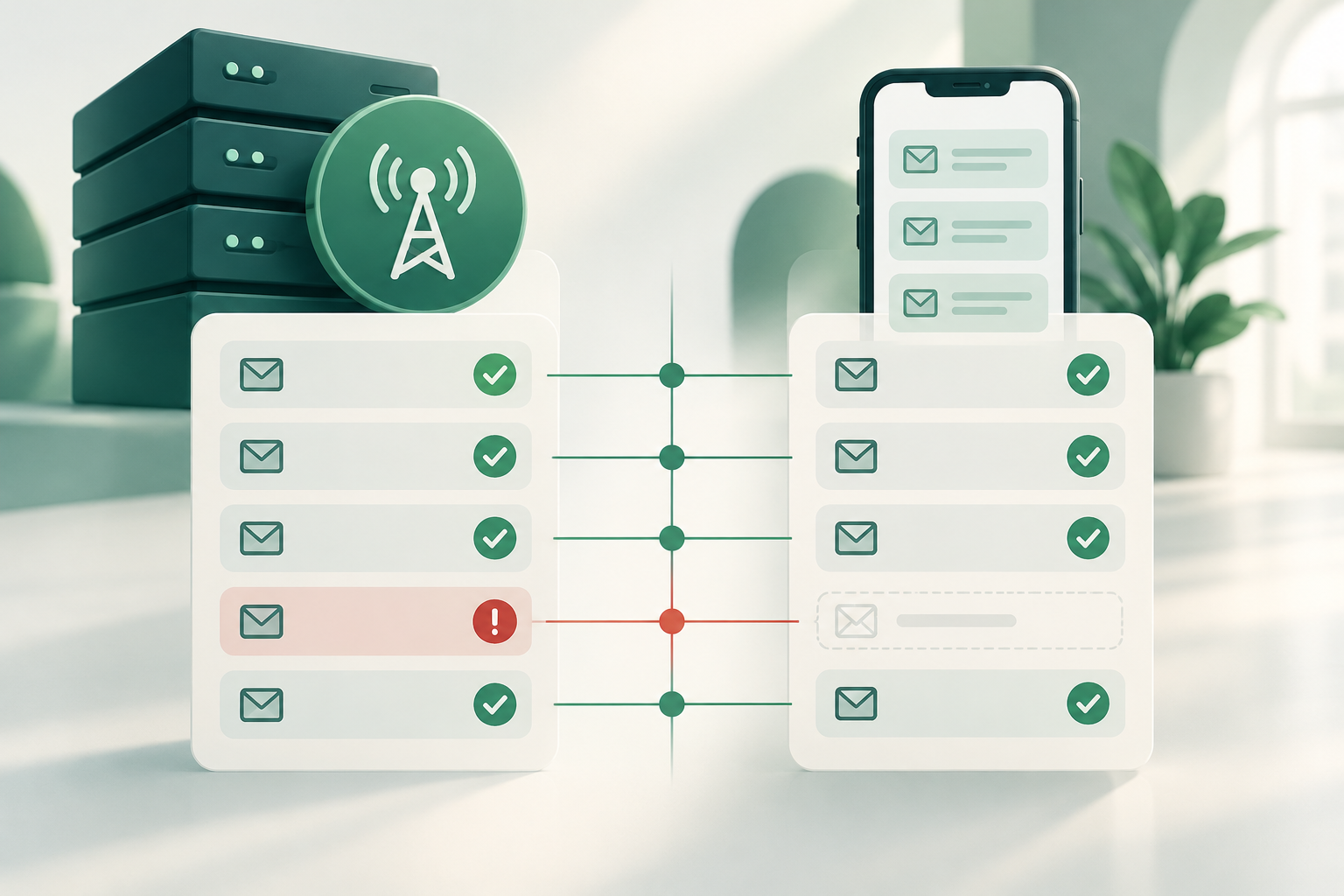
A DLR received from the provider and receipt observed on a test mobile are distinct signals. The former reflects the status reported by the messaging chain; the latter indicates what was observed at a specific test point. A DLR marked as delivered does not, by itself, prove that the message reached the final recipient’s device.
When a receipt test is available, keep both signals separate and link them using the available identifiers and timestamps. If the provider reports delivery but the test device does not receive the message, document and investigate the discrepancy; do not automatically attribute its cause to the route or generalize the test result to all traffic.
Test observations also have limits: they apply to the scenario, destination, device, and time evaluated. Identify the source and scope of each signal to prevent a point observation from being mistaken for a general measure.
- Label each field as provider-reported, test-observed, or internally calculated.
- Record what evidence allows records to be matched and which cases could not be matched.
- When comparing tests, keep agreed parameters constant and repeat the scenario to check consistency.
Define a measurement contract before aggregating data
A measurement contract is an explicit internal definition of how data are captured, interpreted, and aggregated. It is not a universal standard: the available sources do not establish general rules for denominators, windows, or normalization. The team should document its own decisions and keep them stable so results can be compared.
For each metric, describe the event counted, required fields, units, included and excluded statuses, denominator, time window, and applied time zone. Include the data source and aggregation rule. If the definition changes, assign a new version and avoid silently mixing it with the previous one.
For route tests, also retain the relevant scenario details, such as destination, network, test number, and route reference where available. These parameters help determine whether two measurements represent comparable conditions.
- Specify whether the rate is calculated from messages sent, accepted, with a known outcome, or another population defined by the team.
- Document how pending, failed, unknown, and late statuses are handled, without assuming they mean the same thing across sources.
- Set the start and end of the window and the time zone; retain the original timestamp precision where possible.
- Record units and conversions, such as for durations, before aggregating or displaying results.
Controls for identifying missing fields, schema changes, and discontinuities
Controls should compare each incoming dataset with the expected definition, not merely check whether the loading process finished. A table may continue to arrive even when columns are missing, types have changed, or new values appear. Treat these checks as proposed operational practices; they do not presume that any particular source has changed.
Check that required fields are present and correctly typed, review record volumes and the proportion of null values, and look for unrecognized statuses. Also check for possible duplicates using available identifiers and a documented deduplication rule. Do not remove records just because they appear repeated: first validate what each row represents and how its identifiers are generated.
Watch for discontinuities in counts and in status or timing distributions. A variation may reflect traffic changes, a capture incident, or a change in definition; the control flags a signal to review but does not, on its own, prove the cause.
- Validate required fields, types, allowed values, and new fields before publishing aggregates.
- Compare counts, nulls, and records without identifiers against compatible earlier windows.
- Flag potential duplicates and retain the rule applied to resolve them.
- Flag unknown statuses or format changes for review rather than mapping them automatically without an audit trail.
- Record capture interruptions and incomplete periods so they are not interpreted as an absence of failures or a drop in traffic.
Preserve provenance, definitions, and transformations
Every published metric should be traceable to its inputs and calculation rules. Store the source, time of receipt, schema version, and metric-definition version. Also record transformations, including status normalization, unit conversions, deduplication, filters, and aggregations.
Keep the received value separate from the derived value. This makes it possible to review whether a difference originated in the input data, a status mapping, or a later operation. If a source or field is unavailable, note it as a limitation rather than inferring it.
For test signals, retain the test context and the evidence supporting each observation. Comparing DLRs with observed receipt requires being able to identify which records were matched and which were not.
- Keep the original data where possible and avoid overwriting it with a normalized version.
- Associate each aggregate with its period, sources, filters, definition version, and calculation date.
- Document status-mapping rules and changes to those rules.
- Disclose relevant limitations: incomplete data, test-only observations, or the absence of an independent signal.
If a source changes, quarantine the data and rebuild a compatible comparison
When a validation fails or an unexplained discontinuity appears, avoid mixing new records into the previous series as if they were equivalent. Preserve the received data, flag the affected interval, and pause publication of comparisons that depend on questionable fields, according to the impact of the change.
Next, identify what changed: schema, statuses, denominator, source, time zone, window, or transformation. If possible, recalculate both periods using a common definition based on the available data. If that is not possible, present the series as not directly comparable and explain from which point the measurement changed.
Do not silently fill missing fields or map new statuses by analogy without validating their meaning. If a provisional decision is necessary, document the rule, affected period, and uncertainty.
- Isolate or label affected records before generating comparative metrics.
- Compare the old and new definitions, including denominators and inclusion rules.
- Recalculate only when sufficient data and a compatible rule for both periods are available.
- If a comparable baseline cannot be reconstructed, disclose the break instead of claiming a trend.
Operational example: investigating an apparent change in DLR rate
Suppose a report shows a change in a route’s DLR rate between two periods. Before attributing it to the route, check that the rate uses the same definition and denominator in both periods. Also verify that the DLR source, included statuses, windows, and time zone have not changed.
Next, inspect field coverage, records without identifiers, unrecognized statuses, and potential duplicates. If a receipt test is available, separate provider DLRs from what was observed on the test mobile and review matches using the available identifiers and timestamps. A discrepancy is a finding that requires investigation, not an automatic explanation for the variation.
If the analysis finds a schema or denominator change, mark the time boundary and recalculate using a common definition only if the data allow it. If you cannot do so, communicate that the comparison is affected by a measurement change. Any conclusion about route performance should wait until the baseline is comparable.
- First: validate the definition, source, window, and denominator.
- Next: review record quality and matching between signals.
- Finally: decide whether recalculation is possible or whether a comparability break should be declared.
Checklist before publishing a comparison
Before using a metric for procurement, operations, or quality decisions, record what was measured and what cannot be concluded. A clear publication lets another person reproduce the calculation and distinguish observed evidence from limitations.
bullets
- Are the metric definition, denominator, and included statuses the same across the periods being compared?
- Are the source, schema, units, time zone, and time window documented?
- Have missing fields, nulls, new statuses, potential duplicates, and capture gaps been reviewed?
- Can each transformation and definition version be traced back to the source data?
- Are provider-reported DLRs distinguished from independent receipt observations?
- Are the test scope, parameters, and limitations described?
- Is any break that prevents a direct comparison disclosed?
Frequently asked questions
Does a successful DLR prove that the SMS reached the recipient’s mobile?
Not by itself. It is a status reported by the messaging chain. Receipt observed on a test mobile is a different signal and describes only that test scenario.
What should I compare before interpreting a change in rate?
Check that the definition, denominator, included statuses, source, window, time zone, and transformations match. Also review whether fields are missing, records may be duplicated, or capture was interrupted.
What should I do if a source’s schema changes?
Flag the affected interval, preserve the received data, and avoid simply mixing it with the previous series. Investigate the change and recalculate using a common definition only if sufficient data are available; otherwise, disclose the comparability break.
Does a discrepancy between DLRs and test receipt prove a route problem?
No. It documents a difference between two signals that needs investigation. Review the matching, scenario, and available records, and avoid attributing a cause without sufficient evidence.
Sources consulted
- SMPP Protocol Specification v5.0SMPP Developers Forum
- Pruebas de entrega de SMS A2PRoutesms
- Funciones del probador de SMS de TelQTelQ
- DLR falso: qué es, cómo funciona y cómo detectarloTelQ