A2P SMS Log and DLR Retention: Timeframes, Access, and Traceable Deletion
A practical guide to defining an A2P SMS log and DLR retention policy based on purpose, minimization, restricted access, traceability, and verifiable deletion.

SMS record retention is an operational, security, and governance decision
A2P SMS log and DLR retention should not be determined by applying one fixed period to all data. A message send creates evidence that can be useful for support, reconciliation, fraud investigations, quality analysis, incident resolution, and defending claims. At the same time, some of that evidence may include personal data, content, or information that could facilitate the re-identification of an individual or campaign.
Where the GDPR applies, the principles of purpose limitation, data minimization, and storage limitation require identifiable data to be kept only for as long as necessary for specific, explicit, and legitimate purposes. Sector-specific, tax, contractual, regulatory, or procedural obligations applicable to each organization may also affect the decision.
A defensible policy is not the one that retains the most data for the longest time. It is the one that can explain, for each record class, what purpose it serves, who needs it, what access they receive, when its access level changes, and how it is deleted or anonymized when it is no longer needed.
- Define the purpose before setting the retention period.
- Treat content, phone numbers, identifiers, metadata, and technical events separately.
- Identify applicable obligations by jurisdiction, contract, and business function.
- Assign owners responsible for approving, implementing, and reviewing the policy.
- Validate applicable retention periods and exceptions with legal and privacy advisers.

What evidence an A2P SMS send generates
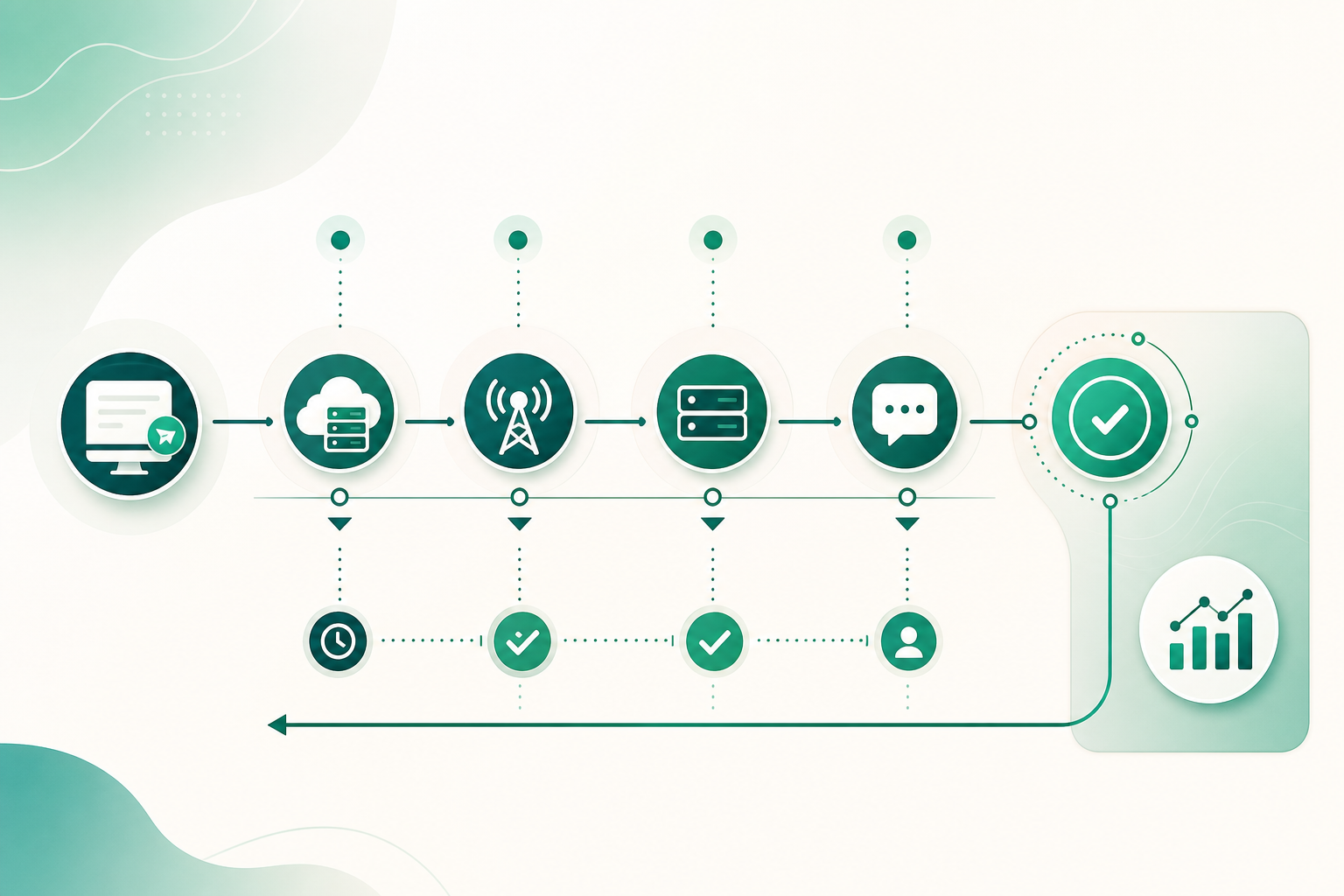
A retention inventory begins by following the technical lifecycle of a message. The initial request may contain account data, credentials or integration context, destination, sender, content, sending parameters, and identifiers generated by the client or platform. Technical acceptance may produce a message identifier, timestamp, and validation or queuing result.
During routing and processing, operational decisions, error codes, attempts, status changes, provider or network references, and timestamps may appear. Later, callbacks or DLRs may be received. Reconciliation adds records linking requests, statuses, outcomes, usage, and potential disputes.
Not all of these elements should be retained together or for the same period. A support team may need a correlation identifier and a sequence of statuses without requiring the full SMS body. A finance team may need evidence of billable events, while quality analysis may rely on aggregated or pseudonymized data.
- Request: account or client context, destination, sender, parameters, content, and source ID where available.
- Acceptance: message ID, time, validations, and admission result.
- Processing: queuing, routing, error, retry, and status-change events.
- DLRs and callbacks: reported status, receipt time, correlatable reference, and technical event source.
- Reconciliation: links between the request, events, outcome, and required administrative records.
What a DLR means, and what it does not prove
A DLR should be treated as a status event reported by the SMS infrastructure. The 3GPP TS 23.040 specification describes the SMS-STATUS-REPORT as a report issued by the service center when the message status is concluded, with outcomes including successful delivery to the SME or the inability to forward due to temporary or permanent errors.
This record is valuable for operations and reconciliation, but it does not necessarily constitute independent proof that a person read, understood, or acted on the message. The exact meaning of the received status should be retained together with its source, timestamp, message reference, and any transformation applied internally.
In addition, the availability of status reports is optional in the SMS service. Therefore, the absence of a DLR should not automatically become a conclusion about final delivery. A mature policy distinguishes between “no DLR received,” “a reported status was received,” “the status was normalized internally,” and “independent additional evidence exists,” where applicable.
- Record the original status value whenever possible.
- Retain the technical source and DLR receipt timestamp.
- Document status-normalization rules to prevent ambiguous interpretations.
- Do not present a DLR as evidence of reading, understanding, consent, or conversion.
- Do not classify the absence of a DLR as conclusive failure or success without applicable technical context.
Build a minimum inventory and classify the data
The inventory should be detailed enough to determine retention and access, but practical enough to keep current. A useful classification separates message content, personal or potentially identifiable identifiers, routing metadata, technical events, account data, and control data.
Content typically requires particularly strict assessment. It may include OTPs, transactional notices, order references, commercial information, or other sensitive data depending on the use case. Retaining it by default for broad troubleshooting increases exposure and should not be justified solely by operational convenience.
Correlation identifiers make it possible to reduce the need to display sensitive data in dashboards, tickets, or exports. TS 23.040 contemplates message references that link related operations, providing a technical basis for correlating a request and status without reproducing content in every view.
- Content: SMS body, templates, variables, and contextual attachments where applicable.
- Identifiers: message ID, client ID, provider reference, campaign reference, or correlation reference.
- Metadata: source, destination, sender, route or routing context, timestamps, and technical parameters.
- Technical events: acceptance, status, error codes, callback, retry, and processing outcome.
- Account and control data: user, role, organization, configuration changes, queries, and exports.
Link each category to a specific purpose
Purpose determines what to retain and for how long. Support may need to reconstruct a specific incident; billing and reconciliation may require evidence of relevant events; fraud and security may require signals to investigate anomalous behavior; quality may need status and latency series; auditing may require access and change logs; and a claim may require preservation of a defined set of evidence.
The key is to avoid generic purposes such as “just in case” or “for future analysis.” Describe the operational use, owner, data population, proposed period, and why a less identifiable version would not be sufficient. Where feasible, replace event data with aggregated metrics, counts, or pseudonymized datasets.
Opt-out and revocation requests also deserve a specific category. In the United States, the FCC recognizes certain SMS responses, including “stop,” “quit,” “end,” “revoke,” “opt out,” “cancel,” and “unsubscribe,” as reasonable means to revoke consent in cases covered by its decision. Your organization should assess the applicable rules, but operationally it is advisable to record the receipt, processing, and outcome of these events in a controlled manner.
- Support: resolve a defined incident and verify event sequences.
- Reconciliation: link requests, statuses, and relevant administrative records.
- Fraud and security: investigate anomalies with proportionate, traceable access.
- Quality: analyze DLR consistency, availability, errors, and technical behavior using minimized data.
- Audit: demonstrate who accessed data, changed a configuration, or performed an export.
- Claims and obligations: preserve only the required scope, with a review date.
Apply a phased model: active, restricted archive, and final disposition
A phased model helps prevent all records from remaining indefinitely in operational systems. The active phase contains the data needed for monitoring, day-to-day support, immediate investigation, and operational processes. It should include the smallest set of data and users compatible with those tasks.
Once the immediate operational need has ended, certain records may move to a restricted archive if a documented purpose remains, such as reconciliation, an applicable obligation, a specific dispute, or an open investigation. An archive is not an automatic extension of production: it should reduce access roles, limit query functions, and prevent information from being used for unapproved new purposes.
When the purpose and any valid exception end, apply deletion, anonymization, or aggregation according to the required outcome. NIST describes log management as a continuous organizational process, and its sanitization guidance emphasizes that effective deletion requires measures appropriate to sensitivity and validation of disposition.
- Active phase: available for daily operations under role-based access.
- Restricted archive: exceptional, justified, and logged access.
- Final disposition: verifiable deletion, irreversible anonymization where appropriate, or aggregation with no identifiable need.
- Review: periodically verify that records do not remain in a phase through inertia.
- Exception: apply limited retention to a defined dataset, with an owner and reassessment date.
How to define retention periods without copying an arbitrary number
There is no universally valid technical retention period for logs, DLRs, or SMS content. The decision should start with the specific purpose and be checked against applicable legal, regulatory, tax, contractual, and procedural obligations. The fact that a category is useful does not justify retaining it indefinitely; nor does a common industry figure replace a documented analysis.
For each category, ask verifiable questions: What decision, incident, or process can this data resolve? When does it cease to be necessary for that purpose? Is there an applicable obligation requiring or permitting retention? Can the purpose be achieved with pseudonymized or aggregated data, or with fewer fields? What harm would premature deletion cause compared with the additional exposure of retention?
Document the reasoning, not only the outcome. If the period changes by customer type, jurisdiction, product, contract, or traffic class, the policy should reflect those differences and the technical mechanism that applies them.
- Exact purpose and data population.
- Applicable obligations and commitments, validated by responsible functions.
- Actual operational need and the time window in which the data is used.
- Less identifiable alternatives, such as pseudonymization or aggregation.
- Privacy, security, fraud, claims, and evidence-loss risks.
- Technical ability to apply the period consistently across systems, replicas, and copies.
- Decision owner, approval date, and review date.
Control access and reduce content exposure
Logs are not automatically harmless. A combination of destination, time, sender, account identifier, and delivery result can reveal activity patterns. Content can significantly increase risk. Access should therefore be based on roles, need to know, and segregation of duties.
A support operator should not automatically receive the same capabilities as a security administrator, reconciliation owner, or person authorized to respond to a legal request. Design views with minimized fields: for example, correlation identifiers, statuses, and timestamps rather than full content or bulk exports.
Log sensitive queries, exceptional access, searches using personal identifiers, retention changes, and exports. Access traceability supports both security and accountability. Periodically review permissions, privileged accounts, and access justifications.
- Apply distinct roles for support, operations, security, privacy, finance, and administration.
- Display content only when necessary for an authorized case.
- Use masking or reduced fields in dashboards and tickets where feasible.
- Require justification and logging for exceptional access to sensitive data.
- Limit exports, log their execution, and protect the destination of exported data.
- Periodically review permissions and privileged access.
Frequently asked questions
Is there a standard retention period for A2P SMS logs and DLRs?
No. The period should depend on the purpose, applicable obligations, and each organization’s legal and operational assessment. Where the GDPR applies, identifiable personal data should be retained only for as long as necessary for the purposes of processing.
Does a DLR confirm that the recipient read the SMS?
No. A DLR is a status event reported by the SMS infrastructure. It can be useful for operations and reconciliation, but it does not independently prove that a person read, understood, or acted on the message.
Does the absence of a DLR prove that the message was not delivered?
Not necessarily. Status-report capability is optional in SMS. The absence of a DLR should be recorded as the absence of that event, not automatically interpreted as conclusive proof of delivery failure.
Should SMS content be retained to resolve incidents?
Not by default. Assess whether the incident can be resolved with correlation identifiers, statuses, timestamps, error codes, and minimized metadata. Content should have stricter controls and access when it is genuinely necessary.
Does deleting a record from the main database guarantee deletion?
No, not on its own. Replicas, archives, backups, exports, and other media must also be considered. Deletion should follow appropriate sanitization controls and checks demonstrating that disposition has been performed according to the policy.
What should a retention exception include?
At a minimum, the affected dataset, specific purpose, owner, applicable basis, authorized roles, start date, review date, and the event that allows the exception to be closed. An exception should not become indefinite and generalized retention.
Sources consulted
- GDPR — principios de limitación de finalidad, minimización y limitación del plazo de conservación (artículo 5)EUR-Lex / Unión Europea
- 3GPP TS 23.040 — capacidades de informes de estado SMS y relación con referencias de mensaje3GPP / ETSI
- NIST SP 800-92 — Guide to Computer Security Log ManagementNational Institute of Standards and Technology
- NIST SP 800-88 Rev. 2 — Guidelines for Media SanitizationNational Institute of Standards and Technology
- FCC 24-24 — revocación de consentimiento mediante respuesta por SMSFederal Communications Commission
- NIST Privacy FrameworkNational Institute of Standards and Technology
- NIST SP 800-63-4 — Digital Identity GuidelinesNational Institute of Standards and Technology