HTTP and SMPP Integration Changes for A2P SMS: How to Validate Compatibility Before Deployment
A guide to defining integration contracts and regression tests for HTTP and SMPP, comparing changes with evidence, and distinguishing technical acceptance from actual delivery to a mobile device.

Which Changes Call for Regression Testing—and What It Cannot Validate
Integration regression testing checks that a change has not altered the technical contract between an application and its SMS interface. It is advisable to run these tests when changing the client application, connector, transport configuration, or the way responses and statuses are interpreted. HTTP and SMPP are different interfaces: a successful test for one does not automatically validate the other.
The scope must be explicit. A successful HTTP response confirms the outcome of the request according to HTTP semantics; it does not confirm delivery of the SMS to the device. Likewise, establishing an SMPP session or receiving a response to a send operation does not, by itself, prove that the recipient received the message. Delivery and the meaning of subsequent statuses depend on the available evidence and applicable documentation.
- Include: request compatibility, fields, agreed encoding, response interpretation, identifier correlation, and disconnection handling.
- Treat these separately: technical acceptance, subsequent message progress, and confirmed receipt on a device.
- Do not use an integration test as a substitute for evaluating route, coverage, or delivery quality.
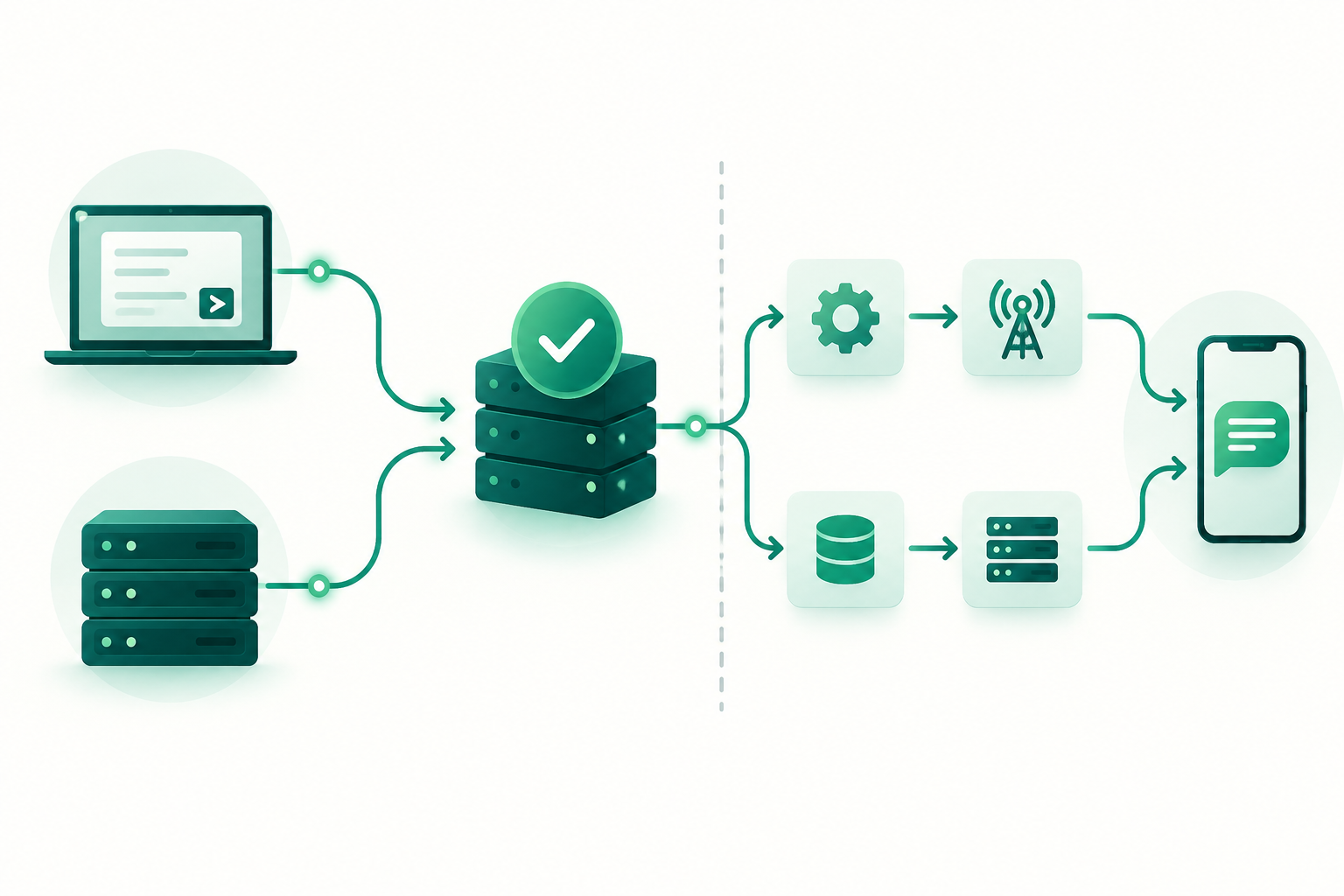
The Technical Contract: Fields, Encoding, Sender, References, and Semantics
Before writing tests, turn the current API or SMPP provider documentation into a verifiable contract. Generic documentation cannot establish which fields are required, how the sender is represented, which encoding is supported, the format of an identifier, or which statuses are returned. Record each rule with its source and confirm any ambiguity against the relevant specification or provider.
For every field, note whether it is required or optional, its format, documented limits, default value if any, and expected behavior when it is missing or invalid. For encoding, define the text cases allowed by the contract and how you will check that the content received by the interface preserves the intended meaning. Do not assume that two connectors interpret characters, senders, or references in the same way.
Also define response semantics: what acceptance or rejection means for that interface, which identifier is returned, and how it is correlated with subsequent status. For SMPP, use the agreed version’s specification and the contracted implementation to interpret operations, responses, fields, and statuses; do not infer details about one integration from documentation for another.
- Maintain a table for each interface listing the field, documented rule, validation, and expected result.
- Keep the request identifier separate from the message identifier if the contract distinguishes them; document their scope and use.
- Keep representative, safe examples—with no real personal data or credentials—so tests can be repeated.

HTTP and SMPP Test Cases: Acceptance, Rejection, and Recovery
Build a test suite for each interface. For HTTP, verify valid requests and inputs that the contract defines as invalid; check that the application interprets the response correctly and preserves the required correlation. HTTP status codes describe the outcome of the HTTP interaction under RFC 9110, but their meaning for SMS submission must come from the API contract.
For SMPP, test the connection and the send operations defined for the version and provider in use separately. Check the protocol response and handling of documented rejections. The SMPP v3.4 specification is the reference for the operations and responses of that version, but the specific details to expect depend on the applicable contract.
Add timeout, disconnection, and recovery scenarios, but do not assume a universal behavior. First establish what the contract says about retries, requests with unknown outcomes, and reconnection. If there is no documented rule, record the case as a pending decision rather than turning an assumption into an acceptance criterion.
- Test technical acceptance using authorized test data and a controlled destination.
- Include expected rejections and confirm the system does not record them as accepted.
- Simulate timeouts and disconnections in a controlled environment; verify the agreed behavior and retain the evidence.
- Do not automatically resend a message with an uncertain outcome unless the contract and application design define how to avoid unintended consequences.
Callbacks and Correlated Statuses: What Does a DLR Prove?
If the integration uses callbacks or status notifications, test the full journey between initial acceptance and the subsequent event defined by the contract. Verify that the notification can be associated with the correct send using the documented identifiers, and that the application distinguishes between no event, an event received, and a reported final status.
Do not assume that callbacks have the same fields, order, or semantics across providers. Check the format, authenticity, repetition, and handling of late events against the integration documentation. If an aspect is unspecified, mark it as an uncertainty and agree on how it will be monitored operationally.
A DLR reports a status within the system that issues and transmits it; by itself, it does not necessarily amount to independent confirmation of receipt on the mobile device. In regression evidence, clearly label what you observed: an API response, SMPP response, callback, or independent device verification, if available.
- Check that each event is correlated with the correct reference according to the contract.
- Record the source and observation time for each status.
- Distinguish statuses reported by the route from independently verified receipt.
Compare Before and After Using Criteria and Evidence
Run the same set of cases against the previous and new versions under comparable conditions. Compare results by interface and scenario, not just the overall percentage of tests passed. A difference may be expected if the contract was deliberately changed; it must be documented, approved, and reflected in the tests before deployment.
Retain the application and connector versions, relevant non-secret configuration, executed case, observed response, and expected result. Store sensitive data in accordance with applicable policies and avoid including credentials or unnecessary personal information in shared logs.
Define acceptance criteria before running the tests. At a minimum, mandatory contract cases must produce the expected result, and unexplained differences must be investigated. Do not set latency, availability, or delivery thresholds without an applicable specification and appropriate measurement.
- Classify each difference as an intended change, a confirmed regression, or an outcome that remains unexplained.
- Compare HTTP status codes and bodies against the API; compare SMPP responses against the agreed version and implementation.
- Attach enough evidence to repeat each case without exposing secrets.
Gradual Deployment and Rollback Without Mixing Tests with Production
Test first in an environment and with destinations authorized for testing, where these are available and documented. Keep test credentials, configuration, and evidence separate from those used in production. If no suitable test environment exists, limit any validation to what is approved for production and to the applicable consent and compliance rules.
Before deployment, agree on who decides whether to proceed or stop, which cases must pass, and which signals require investigation or rollback. Rollback must follow a procedure tested for the application and connector; no universal infrastructure rule can be prescribed without knowing the system.
During any gradual deployment, clearly identify which version generated each request and retain enough observability to distinguish integration errors from subsequent delivery outcomes. Do not interpret a successful technical response as proof of route quality.
- Ensure a previous version or configuration can be restored and that the rollback procedure has been validated.
- Define owners, stop criteria, and minimum evidence before starting the change.
- Clearly identify test traffic and keep it separate from production traffic.
Compatibility Maintenance Checklist
An integration remains compatible when its rules are accessible, its tests are repeatable, and intentional changes can be distinguished from regressions. Review the contract whenever an API version, SMPP specification, connector, or configuration affecting fields, responses, or statuses changes. The reference should always be the current documentation for the specific interface.
Use this checklist before approving a change:
- Is the version and the HTTP or SMPP interface under test documented?
- Does every field, encoding, sender, and identifier have a rule supported by documentation?
- Are there separate cases for acceptance, rejection, timeout, disconnection, and recovery?
- Are callbacks and statuses correlated according to the contract, and is their reporting source identified?
- Does the evidence distinguish technical acceptance, DLR, and verified receipt on the device?
- Are differences from the previous version explained and approved?
- Are owners, stop criteria, and a rollback procedure defined?
- Are testing and production traffic kept separate and compliant with applicable rules?
Frequently asked questions
Does a successful HTTP response mean the SMS reached the mobile device?
No. It describes the outcome of the HTTP request according to the protocol semantics and API contract. By itself, it does not prove delivery to the device.
Does a positive SMPP response confirm receipt of the message?
Not necessarily. It confirms one stage of the SMPP interaction according to the operation and implementation. Receipt on the device requires subsequent evidence, and its meaning must be verified separately.
Can I reuse HTTP tests to validate SMPP?
Not as a substitute for interface-specific testing. HTTP and SMPP have different contracts and exchange patterns. You can share business objectives, but each interface must be validated against its own documentation.
What should I do if the documentation does not specify what to do after a timeout?
Record the uncertainty and agree on the behavior with the provider and integration owners before automating retries. Do not turn an assumption into a compatibility rule.
Is a DLR independent proof of receipt on the device?
Not by itself. It is a status reported by a system in the delivery chain. Identify its source and do not equate it with independently confirmed receipt.
Sources consulted
- SMPP Protocol Specification v3.4, Issue 1.2SMPP Developers Forum
- HTTP Semantics (RFC 9110)IETF
- SMS API documentationVOX Solutions
- SMPP integration documentationWauSMS