A2P SMS Coverage by Operator: How to Verify and Document It
A useful coverage record separates a provider’s claims from numbering references and available tests or observations. Learn how to document scope and limitations without turning a sample into a guarantee.
“Coverage” is not a single answer
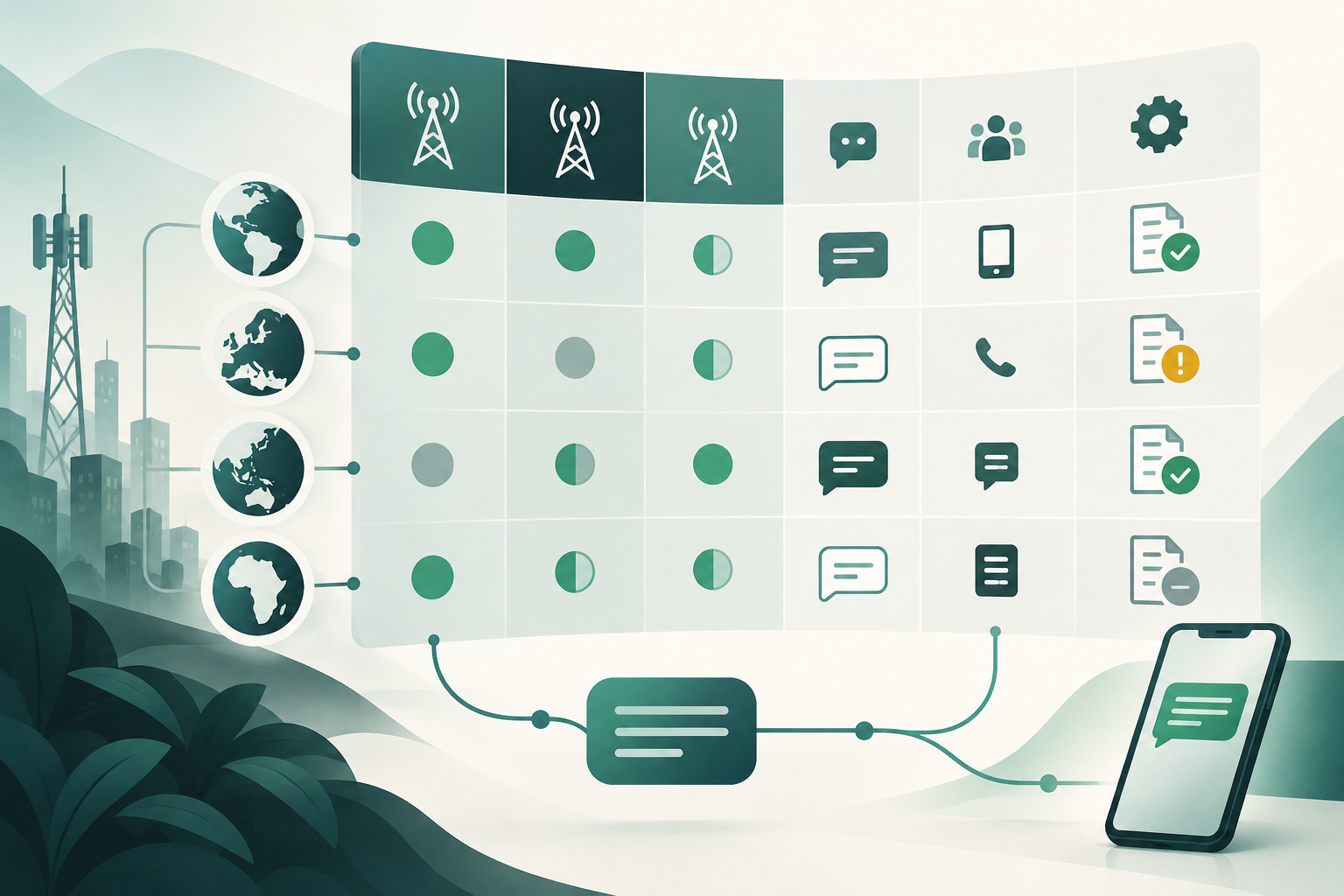
In A2P SMS, saying that a country is covered is not enough to decide whether a route is suitable for a specific use case. Coverage can vary by operator, sender type, message category, connection used, and conditions applicable to the traffic. A general country-level label should therefore be treated as a starting point, not proof that every message will arrive.
This guide uses a proposed operational convention for documenting available information; it is not an externally validated technical standard. Define the scope of each claim: which destination and operator it covers, which sender and traffic type it applies to, what source supports it, and how it was checked. If any of those details are unknown, say so.
- Country and operator: specify the destination or network the information refers to, when known.
- Sender and traffic: record the sender type and intended use, such as OTPs or authorized transactional notifications.
- Connection and conditions: note the method used and any known restrictions, without assuming one route is interchangeable with another.

Four types of information worth keeping separate
As a proposed operational convention, a record can distinguish provider-declared coverage, numbering references consulted, tests performed, and observations available. This organization helps describe where each data point comes from, but the available sources do not support presenting it as a standard or validated technical methodology.
E.164 is an ITU reference for the international numbering plan. The available evidence does not include the recommendation’s contents and does not support specific claims about prefixes, assignments, or portability. Nor does that reference support conclusions about A2P SMS coverage.
Describe any test or observation along with its scope and conditions. Do not present a sample as representative of all destinations, senders, or times. This is a documentation precaution, not a claim about how a route works technically.
- Claim: who states that coverage exists and what scope the claim covers.
- Numbering reference: which source was consulted and what the available information supports saying.
- Test: what was done, when, and under what conditions, if those details are available.
- Observation: what was recorded, over what period, and with what limitations, if that information exists.

Create a record for each country and operator
As an operational convention, record each destination and scope combination separately rather than using a generic label. Keep the source of each data point and the date it was collected or reviewed, if available. This lets readers distinguish between a claim, a reference, a test, and an observation.
Do not combine information gathered under different conditions without saying so. If the sender type, connection method, or message use changes, create a separate entry or clearly identify which information applies to each case.
- Destination: country, identified operator where known, and any uncertainty about the identification.
- Source and date: where the information came from and the date of consultation, test, or review, if known.
- Scope: sender type, legitimate traffic class, connection used, and known conditions.
- Method: claim, numbering reference, test, or observation.
- Result and limitation: what was recorded, what was not checked, and the scope to which it applies.
- Status: use labels defined by the team and note the criteria applied.
Document discrepancies without forcing a conclusion
If two sources provide different information, preserve both signals separately and describe the scope each one claims to cover. Check whether they refer to the same destination, date, operator, sender, and message type. If the sources do not resolve the difference, record the discrepancy rather than choosing an unsupported conclusion.
E.164 is an ITU reference for the international numbering plan, but the available evidence does not provide the recommendation’s contents or support specific inferences about prefixes, assignments, or portability. The available sources also do not document specific GSMA processes for interpreting HLR or verifying A2P coverage by operator.
- Compare the sources’ scope and explain any differences.
- Note the information’s source and date, if available.
- Do not attribute conclusions to a reference that the available evidence does not support.
- If a material discrepancy remains, record it as pending or unresolved.
Plan controlled and authorized tests
A test can be documented around a specific question, such as whether a legitimate test message reaches a particular destination over a specific connection. Use only authorized numbers and respect consent and applicable conditions. The available sources do not support a complete technical methodology for designing coverage tests; present the procedure as a team-proposed operational approach.
Record the conditions and available results. If you conduct multiple tests, identify them by destination, sender, and connection where known. Describe results only within that scope and avoid turning a limited sample into a general promise.
- Define the destination, sender, permitted traffic, and connection before sending.
- Record the date or observation window and relevant conditions.
- Include failed and inconclusive results, if any.
- Do not test third-party traffic without authorization or use tests to evade controls.
- Limit conclusions to what was documented; do not present a sample as a guarantee.
Describe statuses and results carefully
The provided sources do not support precise technical claims about message acceptance, DLRs, or receipt on a handset. When documenting these terms, attribute each status to the source reporting it, and do not present it as independent confirmation of receipt unless you have evidence to support that claim.
The available evidence also does not establish specific delivery-status or latency specifications. If you record a latency figure, state what was observed, its source, and the available conditions, without generalizing beyond what the data supports.
- Identify the source of each reported status and the information supporting it.
- Distinguish a reported status from receipt on a handset when there is no independent verification.
- Describe the source and conditions for any recorded latency figure.
- Do not extrapolate a single result to other senders, destinations, or periods.
Use coverage statuses with explicit criteria
Statuses can serve as internal labels if the team defines what each one means and applies the criteria consistently. They are a proposed operational convention, not a universal certification or technical method validated by the available sources.
If information is insufficient, use a label that reflects that limitation. “Partial” should specify which part of the scope is supported and what remains pending.
- Claimed: a source states that coverage exists for a described scope; the label does not mean the team has tested it.
- Tested: the team recorded a test, its conditions, date, and result; the label does not promise results beyond that scope.
- Observed: the team documented results for a specific period and scope; this does not imply universal coverage.
- Partial: the available information supports only part of the intended scope or leaves conditions pending.
- Unverified: the information is insufficient, inconclusive, or does not match the scope to be confirmed.
Keep records current and communicate their limitations
Assign an owner to review entries and keep a change history as an internal practice. Reassess a record when new information becomes available or relevant conditions change. A review date does not guarantee that the information will remain current.
When sharing a record with customers or routing teams, include its scope and source alongside the status. A table can be useful as long as it does not hide restrictions or turn a claim or sample into a delivery promise.
- Identify who maintains each record and when it was last reviewed.
- Record changes in scope and the source of new information.
- Communicate known restrictions, uncertainties, and cases that have not been verified.
- Do not present a numbering reference or HLR lookup as proof of consent, identity, ownership, or guaranteed delivery.
- Do not publish figures, routes, or results as confirmed commercial data unless they are tied to verified contractual information.
Frequently asked questions
Does E.164 confirm which operator will receive the SMS?
The available evidence identifies E.164 as an ITU reference for the international numbering plan, but does not include the recommendation’s contents or support specific claims about operators or SMS routes.
Do the available sources explain how to interpret HLR to verify A2P coverage?
No. The provided evidence does not document specific GSMA processes for interpreting HLR or support specific technical conclusions from a lookup.
Does a DLR prove that the message appeared on the phone?
The provided sources are not enough to support a technical conclusion about DLRs and receipt on a handset. Document who reports the status, and do not present it as verified receipt unless you have independent evidence.
How many tests are needed to confirm an operator’s coverage?
The available evidence does not specify a number of tests that would support a universal guarantee. Define the test’s scope, record its conditions, and limit conclusions to what was documented.
What should I do if two coverage sources contradict each other?
Record both, compare their scope and provenance, and describe the difference. If the available information cannot resolve it, leave it marked as pending or unresolved.
Sources consulted
- UIT-T E.164: plan internacional de numeraciónUnión Internacional de Telecomunicaciones (UIT-T)
- Especificaciones 3GPP3GPP
- Recursos sobre redes móvilesGSMA